The spirit of the ’80s garage kit boom lives on today via companies like Max Factory, Kotobukiya, and Wave.
When discussing Evangelion, Western fandom ignores the fact that its esteemed auteur, Hideaki Anno, is a total goddamn dork for tokusatsu. Specifically, Ultraman.
As the story goes, the idea behind the Super Dollfie came when Volks’ head sculptor created a large, realistic, ball-jointed doll as a present for his wife. The wife of Volks’ founder subsequently saw the doll and was enchanted, wishing for the ability to offer something like that to customers.
A first-hand report (with plenty of photos!) about the Ma.K Tamagawa Meeting, an annual gathering of Maschinen Krieger fans and modelers.
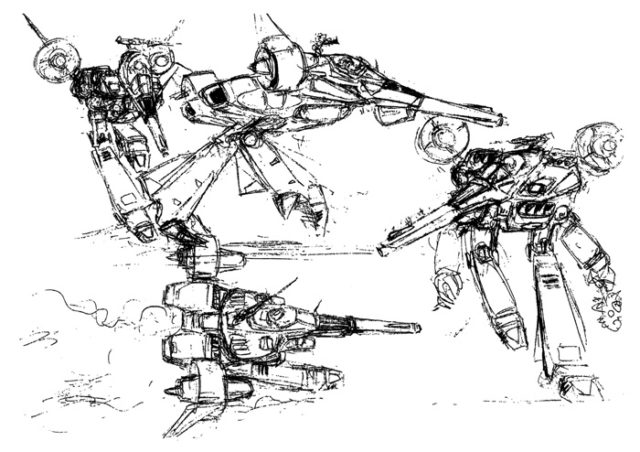
The more innovative aspects of Macross’ mechanical designs weren’t spontaneous creations but the iterative results of years of design work by Studio Nue’s Shoji Kawamori and Kazutaka Miyatake.
Nestled in Tokyo’s Chiyoda Ward is an unglamorous and unassuming part of the city called Jimbocho (sometimes Jinbocho). It’s about 15 minutes by train from Shibuya and has the distinction of being the heart of Tokyo’s used book market.
Long before Gunsmith Cats or Gall Force, Kenichi Sonoda got his break thanks to doujin he published with a group named Comic Circle VTOL.
Originally conceptualized at the height of the real robot boom as a 26-episode TV series called Omega City 23, Megazone 23 went through numerous changes and iterations before it became a cutting edge OVA. For the first time, the original pitch document of Omega Zone 23 is available to read in Japanese and English.
Seemingly everywhere during the VHS era, this early standout in the girls n’ guns genre began as a 3D photo novel and a series of garage kits.
Distributed exclusively to the model kit shops and retailers, the Hyper Dorvack Document helped sell Dorvack model kits using the design sensibilities of Makoto Kobayashi.