
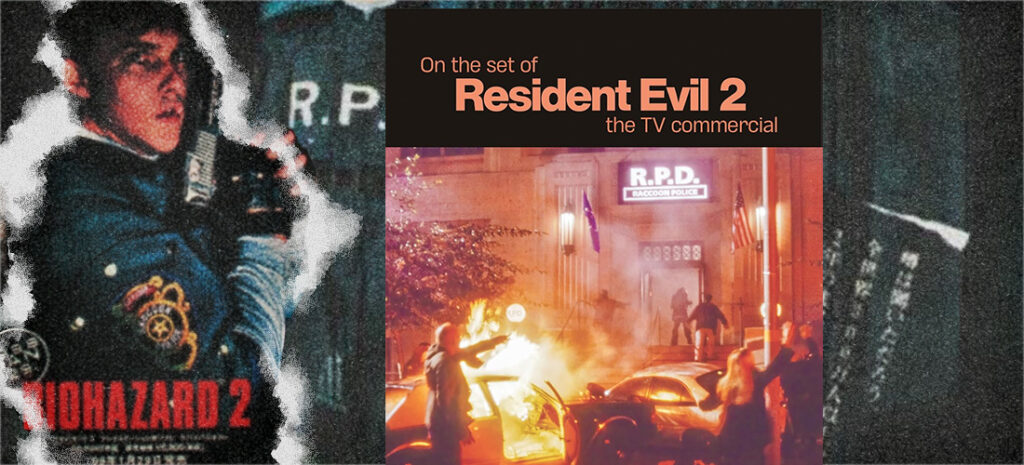
This is an article about the dead who walk. The old craftsmanship of film, the mechanics of media, the monsters on film, and the men who made them.
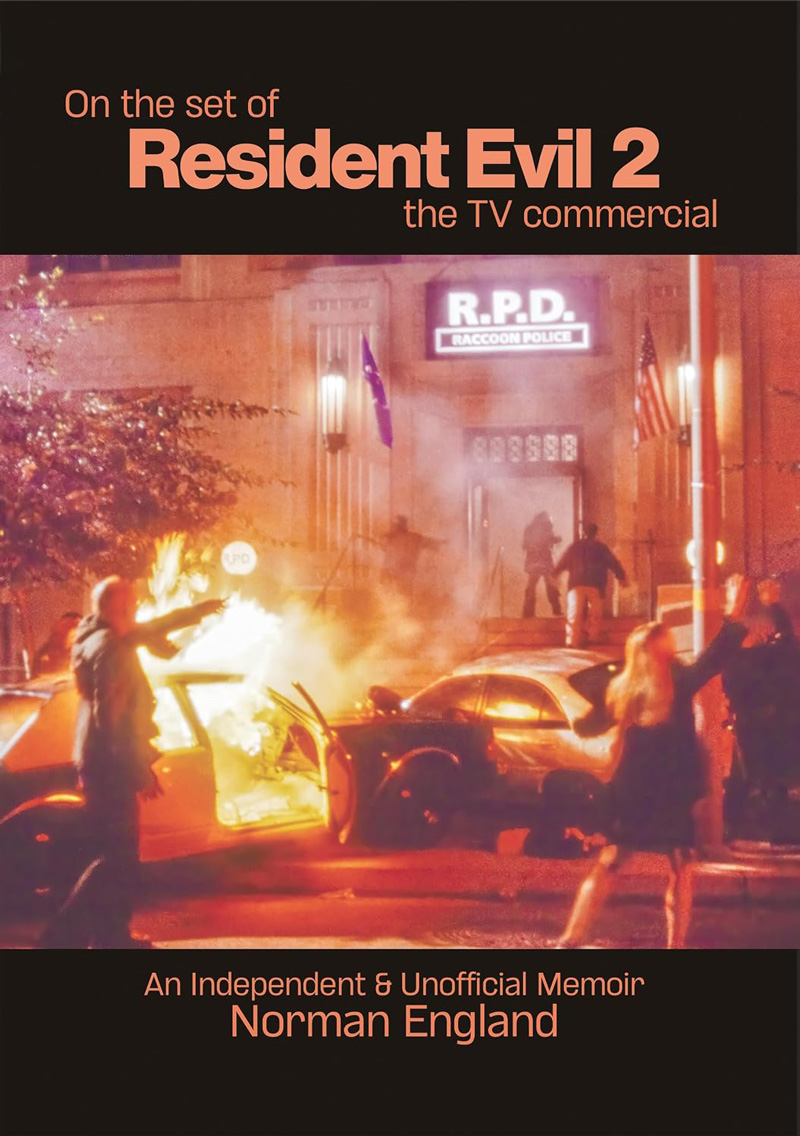
On the Set of Resident Evil 2: The TV Commercial (available exclusively on Amazon in paperback and Kindle editions) by Norman England recounts the production of the Resident Evil 2 commercial helmed by director of Dawn the Dead, Martin, and There’s Always Vanilla, George Romero. England (author of Behind the Kaiju Curtain: A Journey Onto Japan’s Biggest Film Sets and Ring of Fear: Dispatches from the Trenches of Japanese Genre Film Sets), has lived in Japan since the early ’90s as a writer, translator and photographer with his work appearing in Zimmerit adjacent magazines Hobby Japan and SMH. On the Set of Resident Evil 2 recounts how he was recruited by Capcom to act as a bilingual liaison between Romero and video game developer on set, and take photographs on the set. Along with England’s journals written shortly after the shoot in 1997, the book contains new commentary, collected interviews, press clippings, storyboards, and a plethora of on-set photographs.
As I write this review the video game industry is in tailspin. Growing RAM prices, massive layoffs, and even the mere idea of owning physical copies of your games is in peril. Journey back to late 1997, a time of growth and escalation for Sony’s 32-bit juggernaut, the Playstation, and the rapidly changing landscape media. These journals offer a sorta multifaceted glimpse into this moment in time. Norman England, our intrepid author, was scouted for this gig by Capcom because of the liner notes he wrote for the Japanese Dawn of the Dead LaserDisc (imagine getting any kinda employment today for LaserDisc related reasons!). The machine that is (was?) the Japanese print industry whirs and produces clippings for film buffs and video game fans, snapping photos of fresh faced American actors along the way. Leon is portrayed by Brad Renfro, an actor who was on a path to challenge even Dicaprio in the realm of movie heartthrobs, until drug addiction claimed his life in 2008. The extensive “Print Media Archive” section is a graveyard of publications past and shows the reverberations one thirty second commercial made across so many magazines.
Originally this commercial was only aired in Japan (it was a time when a Hollywood actor doing a commercial for the Japanese market was a dirty, but lucrative, little secret), and it offers a glimpse into a what-if world where Romero’s canceled Resident Evil film became a reality. This was a time when splatter filled zombie films were not a part of the cinematic zeitgeist (something Resident Evil franchise had a hand in reviving). The gratuitous and expertly slap-dashed gore films of the 70s and 80s had subsided, with the ’90s ushering in ironic detachment of Scream and fresh-faced MTV-ready teen actors (Scream is a recurring specter haunting this book as cast and crew ruminate on it) before the torture porn era of the 2000s made graphic (if sophomoric) shocks fashionable again. The idea of Romero making a film–even if was just an ad–full of lurching ghouls felt like the kind of throwback that only the people behind Resident Evil could concoct.
Another of the luminaries we have lost featured in this book is special effects artist, surrealist, and musician Screaming Mad George. Born Joji Tani in 1956, Screaming Mad George went from Osaka to SVA and became a fixture in the burgeoning New York punk scene with his band The Mad. Screaming Mad would disembowel himself, don bizarre costumes, intercut sounds from Ultra Q as his band laid siege to Max’s Kansas City and CBGB with their proclamation, “I HATE MUSIC, WE LOVE NOISE!” SMG left the east coast for the west, as a special effects artist for films such as Society, Bride of Re-Animator, and Big Trouble in Little China, which is where he enters this book. SMG was tasked with bringing the undead denizens of Raccoon City to life and England explores his workshop strewn with latex monstrosities inhabit a workshop strewn with remnants of films such as from Guyver, and Space Truckers (a film that also featured the work of Hajime Sorayama and Yasushi Nirasawa). England marvels at some eyeball masks and SMG mentions they were from the film Freaked, he quietly laments the film’s disappointment at the box office. The original commercial offered us only brief glimpses of these zombies, but here you get a real up close look at SMG’s work, making this book a timely testament to one of the great monster makers.
Capcom did not invent the cinematic game trailer, even as far back as the days of the Intellivision there were ads meant to impart a cinematic scope to video games. But Resident Evil 2 was no Tron: Deadly Discs. Hideki Kamiya took the essence of the American horror and action film and distilled it into a crowning achievement for the PS1, and the conceit behind this commercial was an advertisement to match. Keiji Inafune acted as producer for the ad and set out with a goal to not simply make a commercial, but a mini-movie (those ambitions to make movies never totally left Inafune, he took a crack at a Dead Rising short and I’ve heard rumors about a scrapped Lost Planet film…). Inafune is portrayed as being just as gleeful at watching Romero work as Norman is. England captures the process of location scouting, costume checks, working with actors, and the whole rigamarole that it took to make this 30 second snippet of promotional film a reality. The final advertisement was bundled with a making-of documentary and distributed to video rental stores and movie theaters across Japan. A bygone era for sure.
The book is detailed, but not detached, and England’s journals do not hide how much of a fanboy dream-come-true moment working on this project is for him. George Romero is portrayed not as an auteur, or a force of nature, but as this humble straight talking gentle giant who just happened to make some movies where people are torn apart limb by limb while screaming bloody murder. In a Columbo-esque episode Brad Renfro’s manager scrutinizes Romero at a meeting of the cast and crew at the LA Four Season. “So, what exactly is it that you do?” “I’m… uh, the director?” is all George can offer. Romero is matter of fact, not totally cynical, but not saccharine either. Norman asks if the signature George Romero style can be recognizable in a 30 second commercial. “I doubt it!” But Romero is no grouch, he’s shown to be happy behind the camera and working with actors. We’re often warned not to meet our heroes, but England is more like “the man who suddenly got everything he ever wanted” at the end of Willy Wonka & the Chocolate Factory, just surrounded by exploding cop cars and walking corpses. Before there was Day, Dawn, and Night, there was George Romero, the director of beer and laundry detergent commercials. And even though by 1997 those days were long past, you still see his practicality and warmth shine through.
My biggest gripe with this book is that since it’s printed by Amazon the overall tome feels somewhat flimsy, and even some de-laminating on the cover after a few weeks of flipping through it. I’d still wholeheartedly recommend it for fans of Resident Evil, George Romero, tokusatsu, or if you’re like me (and I know I am), all of the above. I am happy to add this to my ever growing collection of Capcom and Capcom related art books choking my bookshelves. Books about George Romero are also surprisingly few and far between. I still covet my softcover copy of The Zombies That Ate Pittsburgh.
You can see George Romero’s ad, plus the behind the scenes footage from Capcom’s video magazine, Capcom Friendly Club. (Also possibly more unsettling than the zombies is the costumed Mega Man at the start of the video)