For all of the attempts by writers and artists in the West who tried to capture the anime je ne sais quoi in the ’90s, the Montreal-based design studio Dream Pod 9 came as close as anybody. Not by emulating anime sensibilities outright, but by blending styles and ideas from Japanese animation into their own stuff, incorporating plenty of other influences along the way while still trying something new.
At its height, Dream Pod 9 supported four unique worlds across multiple games, had their work adapted as an animated TV show and two video games, and carved out a space for themselves in the complicated and contested tabletop gaming marketplace. They were known for evocative but sometimes complex game systems and helped push the idea of an ever-progressing game “meta” — a game world with an advancing overarching story told through dedicated plot books.
Heavy Gear arrived in 1994 and it was a game that wore its Armored Trooper VOTOMS influence on its sleeve. Originally, it was a card game, a tabletop war game, and a role-playing game, three different games rolled into one intricately detailed and imaginative military sci-fi setting. Dream Pod 9 (hereafter DP9) also published Jovian Chronicles, a game with intense Gundam vibes that arrived first as a supplement to the mecha role-playing game Mekton and later as its own game. After that there was the post-apocalyptic Tribe 8 (a game without giant robots) and then a sci-fi spin on World War II, Gear Krieg (a game with giant robots). Somewhere along the line there was an attempt at breaking into the movie industry, too.
DP9 still exists, but it’s not the same company it once was. It is a company that has survived in a games industry that has gone through massive turmoil over the last couple of decades. One founding employee still remains, the company is focused on a single game, and they’ve had their fair share of ups and downs.
But still, they persist, continuing to build a sci-fi world that grew out of, of all things, an anime magazine.
BEGINNINGS, TIME, AND ENDINGS
I’m no scholar, but for ancient Romans the god Janus (sometimes written as Ianus) was the god of “beginnings, gates, transitions, time, duality, doorways, passages, frames, and endings.” It’s appropriate then that the story of DP9 begins with a small-print publisher named Ianus Publications. It was founded in 1985 to facilitate the publication of the French-Canadian sci-fi magazine Samizdat published by a college student named Claude J. Pelletier. He described his small print company as intended to “publish both historical papers and science-fiction.” To that end it published a number of anthologies and short-story collections and some genealogical dictionaries, but would soon be known for something else entirely: an anime fanzine.
In 1987 Pelletier discovered Robotech and the TV series inspired him and his friends to start an anime club at their university and publish a Robotech fanzine. In November of 1987 they published the first issue of Protoculture Addicts and quickly attracted the attention of the series’ owner, Harmony Gold. Despite the distance between the fanzine publishers in Montreal and rights holders in Los Angeles, Harmony Gold got wind of the effort and told the college students that they were infringing on their copyrights. An agreement, wherein Protoculture Addicts would pay Harmony Gold “a couple of thousand dollars per year” was reached, and the fanzine was allowed to continue as the “official fanzine of Robotech.”
By the late 1980s the first wave of English-language anime magazines like anime-zine, Japanimation and Animag were showing up in comic book shops and while production values varied, few were representative of what a normal person might think of as a “professional magazine.” Animag was arguably the exception to this. But Protoculture Addicts was as much a magazine as any of these, so continuing to call it a fanzine—let alone an “official fanzine”—seems odd, in retrospect. Perhaps the ever-ambitious Harmony Gold was holding out hope that they’d be able to license the “official magazine of Robotech” to a major publisher at some point.
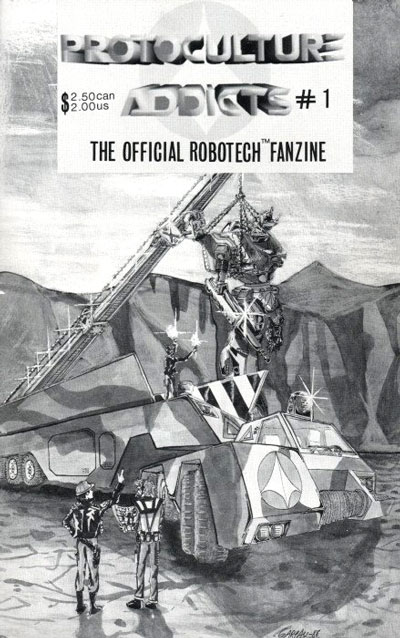
While much could be said of a company like Harmony Gold going after a fanzine of all things, the official recognition seemed to work out in the publisher’s favor. The official status pushed them to pursue advertising, distribution, and a color cover (largely to justify the cover price now needed to cover costs of publishing and the the annual licensing fee they now owed, according to Pelletier). Whatever the reasoning of the dubious legal threats, it at least moved them towards turning Protoculture Addicts into a proper magazine.
For ten issues Protoculture Addicts covered the dwindling footprint of Robotech and the blossoming anime scene in North America before eventually coming to the same realization that a lot of anime fans who got into Japanese cartoons via Robotech did around the same time: it was time to move on.
From issue #11 onward the magazine dropped the “official” association with Harmony Gold and Robotech. Instead it refocused on anime in general, while still retaining the same unusual name. In a 2004 interview Pelletier described Protoculture Addicts during this era as a “Fan Magazine,” no longer a fanzine published out of student dorms, but rather a magazine by fans, for fans.
It was also around this time that Pelletier lost his two closest collaborators on Protoculture Addicts, as Michael Gareau and Alain Dubreuil moved on to more “serious” professions. In their place, Pelletier found new people to work with, including graphic designer Pierre Ouellette. He overhauled the look of the magazine and began working with Pelletier on expanding Ianus Publication’s portfolio to go beyond just an anime magazine.
Ouellette’s redesign of Protoculture Addicts helped it stand out during a time when anime magazines were not exactly known for their competent layouts or design sensibility. Protoculture Addicts, when compared to the contemporary Animerica for example, was clean and consistent. It didn’t have the glossy color pages of Animerica, but it looked professional enough… in PageMaker 4.0 sorta way. That the magazine didn’t get more credit during this era I think had less to do with its own intrinsic qualities and more to do with the geographic distances between Ianus, located in Montreal, and the hot spots of anime importing during the early ‘90s, largely centered around the Bay Area and Southern California.
Venturing beyond Protoculture Addicts, Ianus tried its hand at comic publishing. In 1991 Ianus released The Gates of Pandragon and in 1992 published a three-issue mini-series (cut short from its originally planned six issues) called Cybersuit Arkadyne by Tim Eldred. Eldred, like Ianus, had been active in anime fans circles and was perhaps best known for publishing The VOTOMS Viewer’s Guide. He’ll show up later in this story, too.

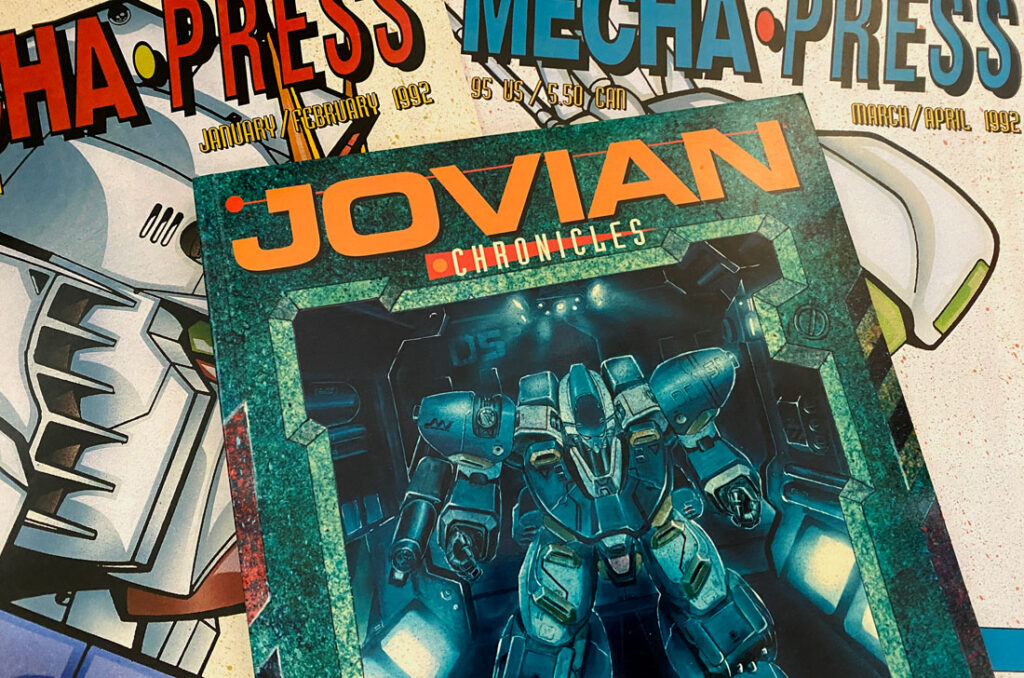
Around this time Ianus also began publishing a new magazine, effectively laying the foundation for Dream Pod 9. The debut issue of Mecha Press was dated January/February 1992 and contained a mix of anime and tabletop games coverage with, as you’d expect, a narrow focus on mecha.
While all of these anime magazines were popping up, the desktop publishing revolution had pushed the role-playing game industry into new directions. Hordes of small-press publishers appeared, eager to publish their own games. But few of these publishers embodied the ’90s quite like White Wolf Publishing, a company formed by the merger of publisher Lion Rampant and White Wolf Magazine. In 1991 White Wolf published Vampire: The Masquerade, a modern gothic horror role-playing game that focused more on storytelling1 rather than treasure, detailed combat resolution, or dungeon crawling.
The success of Vampire soon lead to more games in “the World of Darkness” setting, including Werewolf: The Apocalypse, Mage: The Ascension, and Changeling: The Dreaming. The darker themes of White Wolf’s games reflected certain moods of the era (this was the time of The X-Files and conspiracies about black helicopters and cattle mutilations, after all) and succeeded in part because of that. Vampire was the first game since Dungeons & Dragons that even came close to breaking into the mainstream zeitgeist, helping to spur both a vampire goth kid panic and a short-lived TV show that aired on Fox.
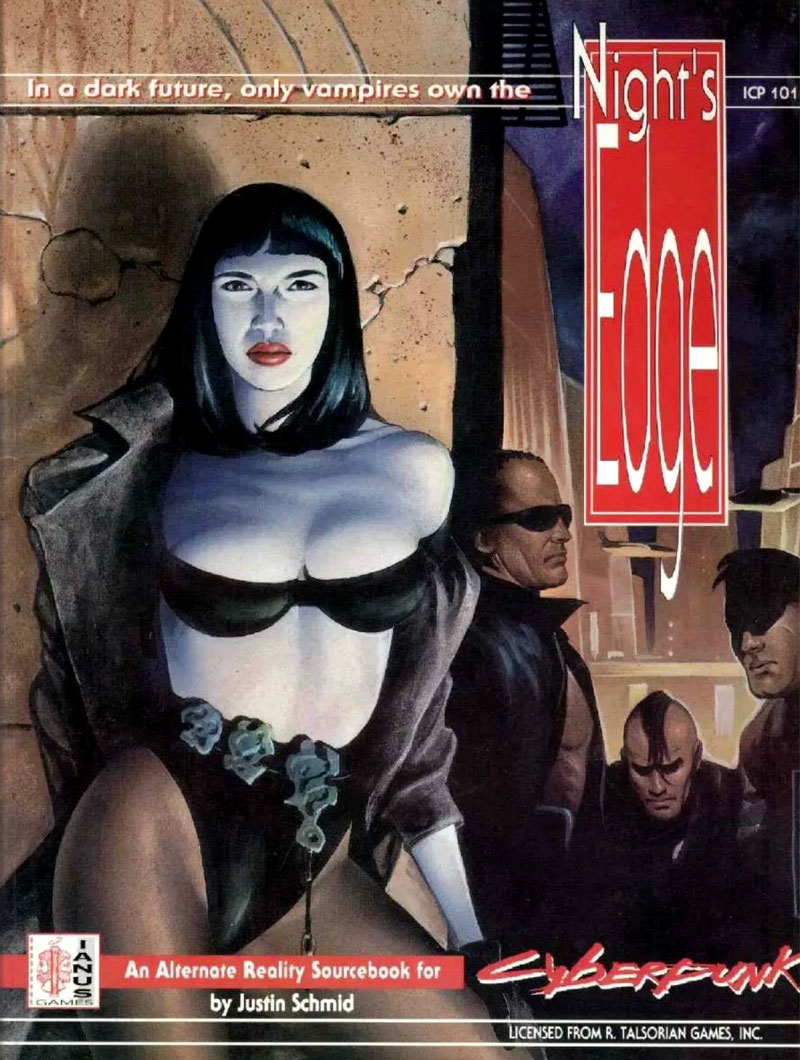
Drawing from the popularity of the World of Darkness, Ianus broke into the role-playing game industry with “Alternative Reality” source books for R. Talsorian’s Cyberpunk 2020 role-playing game. The first book in the series was Night’s Edge, published in late 1992, and it kicked off a series of supplements that blended cyberpunk with horror mainstays like vampires and werewolves. This book seems to have been the first place that the Dream Pod 9 name appears. Alongside the expected information about Ianus Publications was a credit for “Creative team: DreamPod 9.”
RPGGeek.com lists eight source books published by Ianus for Cyberpunk, but that may not be a complete list (it doesn’t include the original Night’s Edge supplement, for example). In retrospect it’s odd that Ianus, with its anime background and two different anime-focused magazines in print, didn’t start with one of R. Talsorian’s other, much more anime-influenced games,2 but that would come a year later.
MECHA PRESS, PROJECT A-KO, AND CARD GAMES
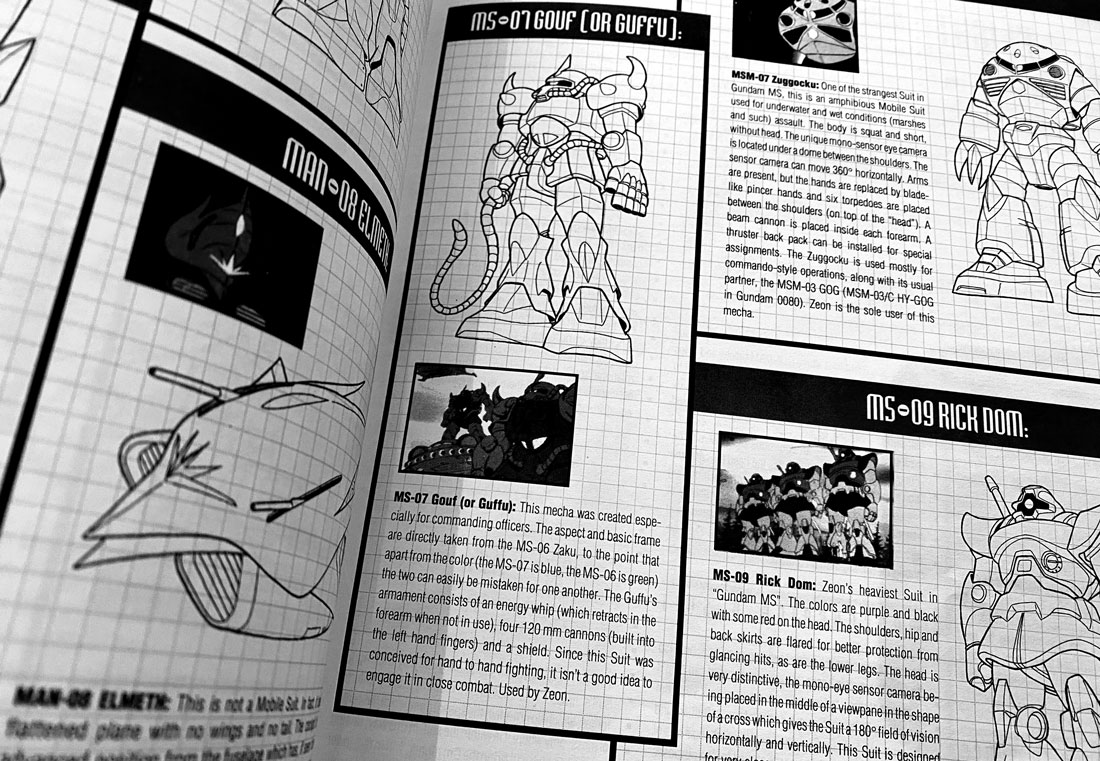
If ever there was a product targeted straight at the heart of mecha fans of the early ’90s, then Mecha Press was it. Half anime magazine, half gaming magazine, each issue focused on a different anime series and included articles about tabletop gaming, model kits, and real-world technology. Mobile Suit Gundam, Patlabor, Gundam 0080, Bubblegum Crisis, and Gundam F-91 made up the cover stories for the first five issues. The rest of the magazine was devoted to coverage of different anime, new rules and stats for games like Battletech or Mekton, and general news and reviews related to giant robots.
It wasn’t unusual to flip through an issue and see background information and episode summaries of Armored Trooper VOTOMS alongside Orguss stats for the game Mecha! and coverage of the latest Battletech books. You’d also find reviews and photos of model kits and gaming miniatures, articles about real-world technology, and techniques for enhancing your plastic model kits or a guide for getting into garage kits. It was an unusual mix that could have only worked during the specific era in which it was published and somehow, it lasted for 17 issues.
As the magazine’s editor Marc A. Vezina explained to me via email, Mecha Press was originally planned as a supplement to Protoculture Addicts, saying “The first idea was to put a mecha-oriented insert in our existing Protoculture Addicts magazine, but as we made plans and gathered material we realized we had more than enough to do a stand-alone publication. The strong visual identity came from DP9’s head graphic designer Pierre Ouellette, the anime content from the [Protoculture Addicts] team and the gaming content from the wargamers in the group (we had already published some game fanzines, so the work came naturally).”
Furthermore, Vezina explained that the group’s particular interest in mecha anime came from a lifetime of watching imported anime that stretched back farther than Robotech. “We were raised on imported translated titles such as Goldorak (UFO Robot Grendizer), Albator (Captain Harlock Space Pirate) or Capitaine Flam (Captain Future). Over the years we moved on naturally to Robotech and then Japanese imports such as Madox-01 Metal Skin Panic.”
Like Protoculture Addicts, Mecha Press benefited from clean, crisp layouts, plenty of original artwork of a high standard, and original cover art that was good, if a bit plain. Issues were filled with small touches that really worked. For example, line art for characters and mecha were typically placed over grid backgrounds just like you’d see in the big Japanese magazines.
In 1993, Ianus Publications published Jovian Chronicles, a 112-page campaign setting for Mekton II, then the preeminent mecha anime role-playing game. Described as a “North American version of Gundam,” Jovian Chronicles featured art by John Moscato3 and text by Marc A. Vezina, who had moved up from Gaming Editor to Editor-in-Chief of Mecha Press.
Jovian Chronicles was a near-future sci-fi story focused on our solar system with a story of conflict between the Earth and its colonies on Mars, Venus, and Jupiter. Visually and thematically captured the mecha zeitgeist of the early ’90s, with mechanical designs that drew heavy influence from popular OVAs of the era like Gundam 0083 and Macross II.
Jovian Chronicles had its origins in a project originally conceived of for serialization in Mecha Press a la Gundam Sentinel in the pages of Model Graphix. First planned for a couple pages an issue, it was soon decided such a format wouldn’t really work and the background developed was combined with the recent license from R. Talsorian for the release of a proper source book.
The concept of an original setting featured in the pages of Mecha Press would be used later for Moonlight Mechanix, a fantasy mecha setting that popped up in a few later issues. I had assumed that this may have been intended to be developed into another DP9 game setting to complement Jovian Chronicles, but Vezina corrected me, explaining “No. Moonlight Mechanix was editor Jean Carrieres’ homebrewed RPG campaign (Mekton-based, I think?). Fun to share but not enough content for publication.”
The first Jovian Chronicles book was followed by a supplement containing a campaign, titled Europa Incident. Despite art duties for this book switching from Moscato to Ghislaine Barbe, the quality remained consistent. Both Jovian Chronicles books featured the Dream Pod 9 logo alongside the Ianus Publications’ logo and set the groundwork for what was to come: original sci-fi settings with anime-influenced designs and artwork presented in a clear and professional manner.
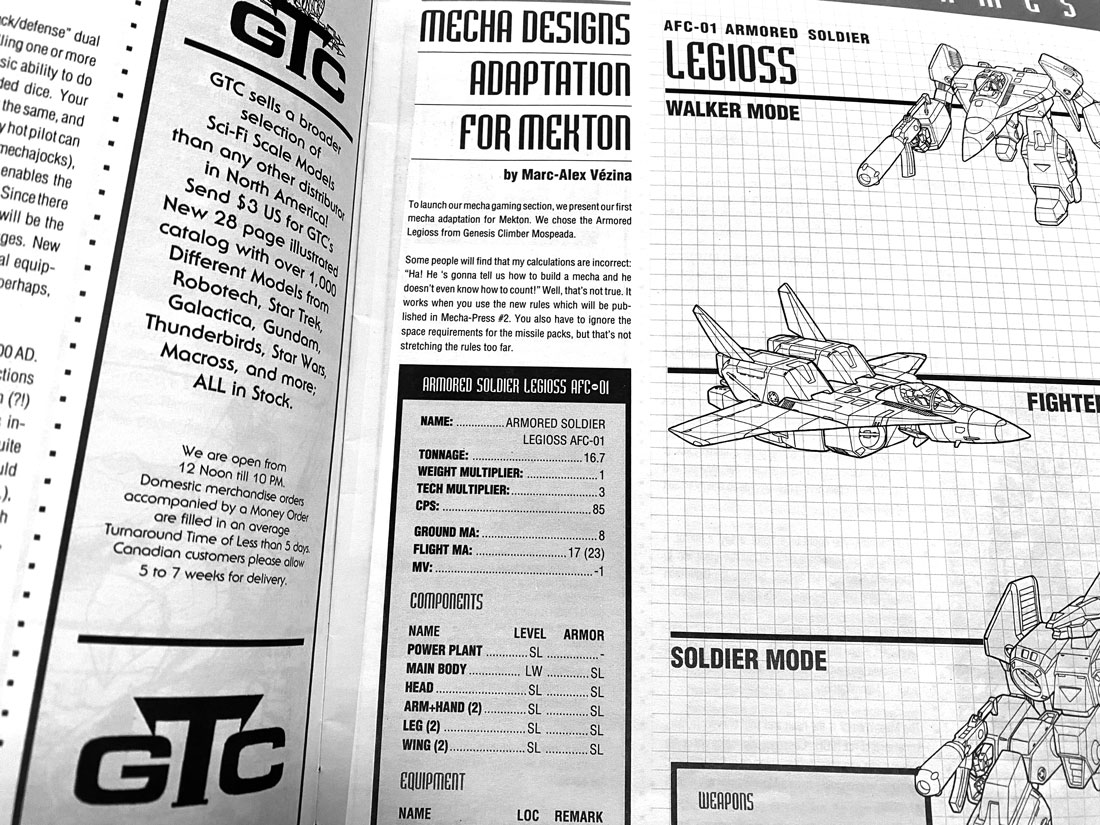
If you think I’m going on too much about the design of Ianus and DP9’s work, then, I suggest you crack open an anime-influenced role-playing game or magazine from around the same time. Even as a young adult largely unaware of the most basic concepts of graphic design, DP9’s efforts struck me as something different. Furthermore, art for role-playing games during this was notoriously inconsistent and DP9’s ability to get consistency not just across a single book but an entire series is noteworthy, even today. That’s all to say that while these old DP9 products look very much of their age, they still look good.
For perhaps the most jarring example of the company’s design acumen, look no further than the Macross II Deck Plans series published by Palladium Books but written and designed by DP9. Palladium Games, the Detroit-based publishers behind the popular Robotech and Rifts role-playing games had grabbed the rights to Macross II when it was released in English by U.S. Renditions and alongside a rule book and a followup book, these three volumes of deck plans made up their entire product line. While each volume featured DP9’s typical design sensibilities, as a whole they clashed with the old school two-column, no frills, paste-up design that Palladium used (and continue to use, even now).
According to Vezina, the collaboration between DP9 and Palladium arose over beers at GenCon, “We had made some deck plans for our own game publications and the Palladium crew really liked them. We were discussing them over beers after hours at GenCon (can’t remember the year) and Kevin [Siembieda] asked if we’d be willing to do some work for their Macross II series.”
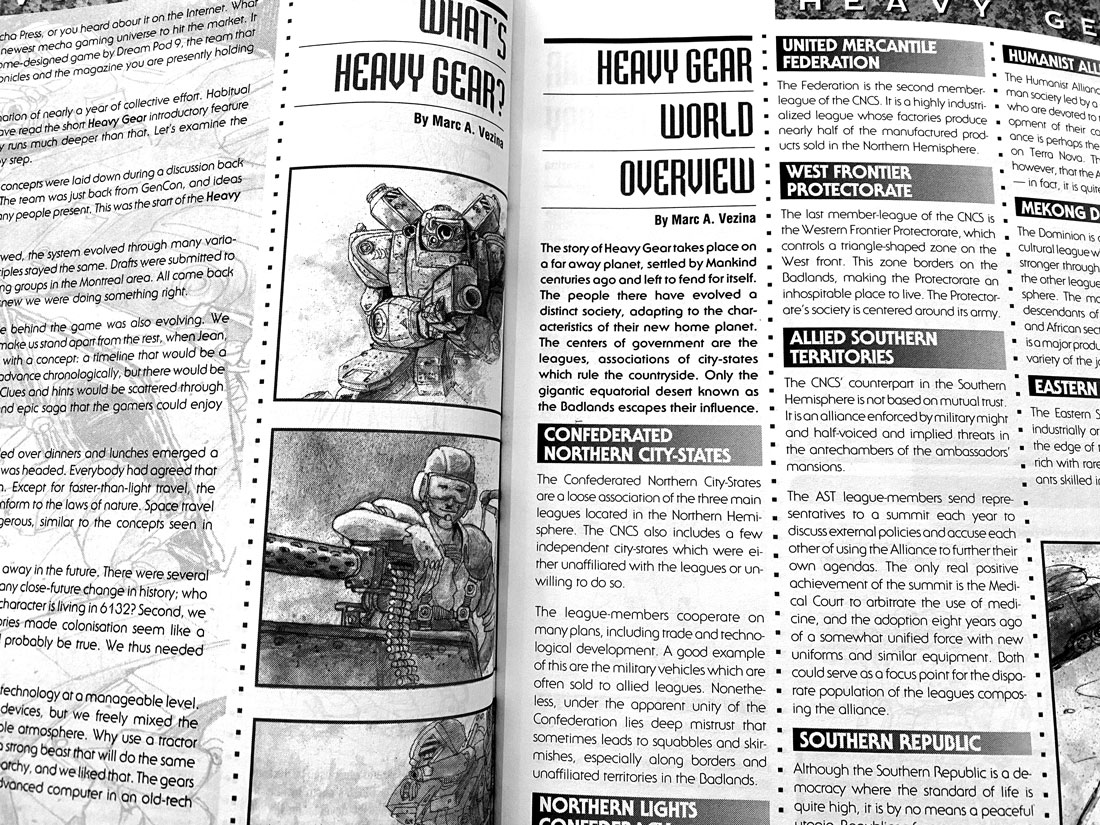
The three volumes of the Macross II Deck Plans would be released throughout 1994—a year that turned out to be a big one for DP9. While development of their newest original mecha game Heavy Gear began in 1993, it made its first public appearance in issue #12 of Mecha Press, dated April/May 1994. Later that Summer at GenCon, they debuted the first game based on their new sci-fi setting: Heavy Gear Card Fighter.
While Vampire: The Masquerade made waves in the tabletop role-playing game space, the really big tabletop gaming phenomenon of the early ‘90s was without a doubt Magic: The Gathering. Following the game’s launch in 1993, Magic sparked a massive collectible card gaming boom that saw just about every games company under the sun try their hand at a collectible card game. DP9’s take on this concept was to ditch the collectible aspect entirely and focus on the cards while also taking inspiration from their anime fan roots.
Heavy Gear Card Fighter was a self-contained game that pitted two gears (the big robots of the Heavy Gear world) against each other in combat. While one expansion was released later and cards appeared in issues of Mecha Press and later with Heavy Gear miniatures, it didn’t require you to buy anything other than the original game. The cards came packaged in a VHS clamshell case, a choice that seemed more deliberately tied to DP9’s other Card Fighter game, Video Fighter: Dragons of Fury.
Video Fighter is a minor footnote in the history of DP9 (although it also tried to blend two popular gaming trends at the time, in this case card games and fighting video games like Street Fighter II), but Heavy Gear Card Fighter wouldn’t last very long, either. While it was incorporated into the first edition of the Heavy Gear rule book, it wasn’t developed further. DP9 released a single expansion for the game before refocusing attention elsewhere. When a second edition of Heavy Gear was published in 1997, the Card Fighter rules were removed.
Both the Card Fighter games and earlier Night’s Edge supplements displayed an ability to combine seemingly disparate trends into a single product. Both products were interesting to be sure, but neither proved particularly successful. DP9’s future was with Heavy Gear.
But, before we get into the launch of Heavy Gear, we need to talk about one last project from this era of DP9. Project A-Ko: The Role-Playing Game.
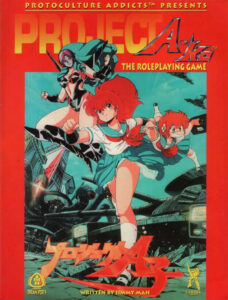
Published in 1994, Project A-Ko: The Roleplaying Game came at a time when anime-inspired role-playing games were increasingly common but properly licensed games were still far and few between. Despite its place in history as perhaps the first licensed role-playing game based on an anime series not focused on giant robots, Project A-Ko: The Role-Playing Game is rarely mentioned when discussing the deluge of anime and anime-inspired games that would follow throughout the late ‘90s and early 2000s.
According to Marc A. Vezina, the game came about because “…we had the opportunity to get the license for cheap based on our connections via Protoculture Addicts, from the publisher that was importing A-Ko at the time in North America.” That publisher was Central Park Media, a video company that had been advertising in Protoculture Addicts and Mecha Press. In a recent interview with Central Park Media head honcho John O’Donnell, he held up a copy of the game as an example of licensing deals that served more as advertising than anything else.
Written by local Montreal anime fan Jimmy Mah, Project A-Ko used a simplified version of the DP9’s house rules system dubbed ‘Silhouette’ that would soon be seen in Heavy Gear. A-Ko’s particular variant of this ruleset was dubbed “Silhouette-A” and was a stripped down and simplified version of those rules intended for, as Vezina told me, “something more streamlined and [a] better fit for a comedy game.”
Project A-Ko also included a Card Fighter combat system with cards—again, like the release of Heavy Gear would the following year—and as a result it functioned as sort of a trial run for the games that were soon to come.
In retrospect, Project A-Ko was a fascinating license to use for a role-playing game because despite its notoriety amongst anime fans of the era and the proliferation of anime cliches within its run time, it was also packed full of references and jokes that would have flown over the head of most English-speaking fans. The book itself was created in such a way that it served as sort of an English-language art book with background material that could appeal to fans even if they weren’t interested in playing the games. In the years to come, plenty of other licensed anime role-playing games would do the same thing.
In 1996 R. Talsorian Games published the Bubblegum Crisis role-playing game and then followed it up with a VOTOMS role-playing game. Both of these books used original production artwork and featured heaps of translated material, making them worthwhile purchases for fans. A few years later Guardians of Order used the same strategy for their games based on Sailor Moon, Dominion Tank Police, Tenchi Muyo!, and others. Heck, even the full name of the Sailor Moon game was “Sailor Moon Role-Playing Game and Resource Book.”
THE ROBOTS WE LEAVE BEHIND
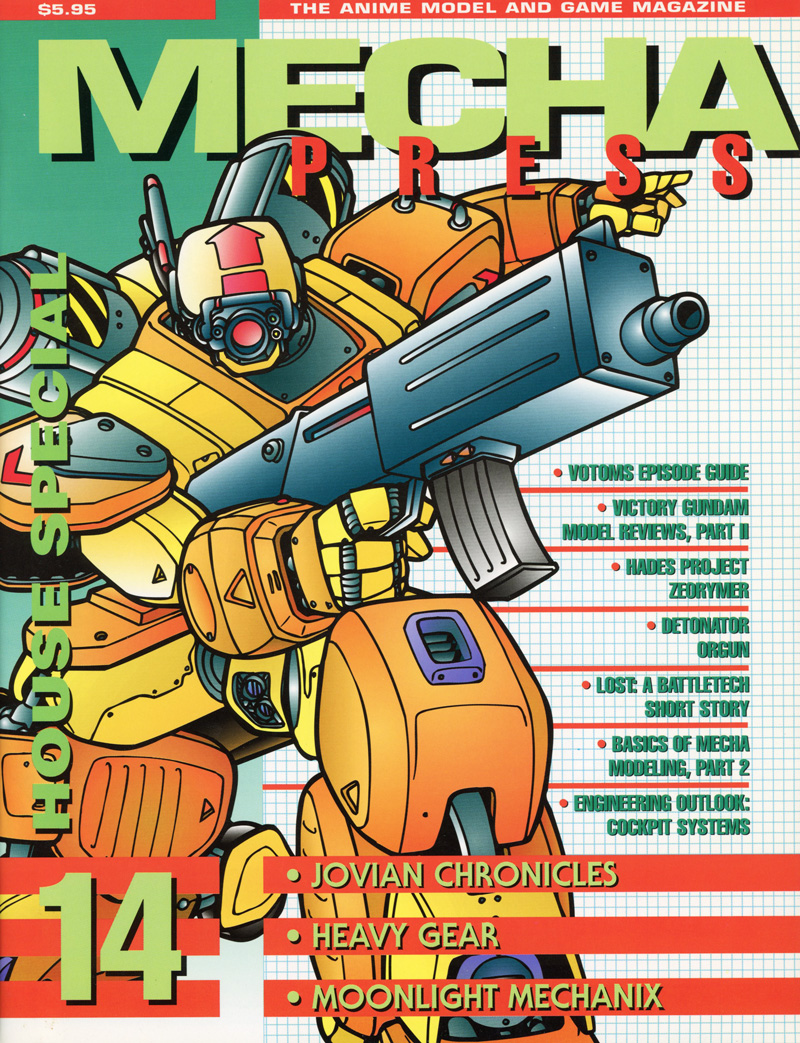
Mecha Press #14 (dated August/September 1994) was dubbed the “House Special” and focused on three original projects from DP9: Heavy Gear, Jovian Chronicles, and Moonlight Mechanix. Each was presented in the same style that the magazine covered mecha anime, with background information, line art, and screenshots (they even used original artwork edited to look like video captures for Jovian Chronicles and Moonlight Mechanix).
Even though there were three more issues to follow, issue #14 really laid out DP9’s new focus and foreshadowed the split between the design studio and Ianus that would come the following year. I can only speculate on what was going on behind the scenes, but sometime in 1995 Dream Pod 9 broke off from Ianus Publications to focus exclusively on gaming publications while Claude J. Pelletier retained control of Protoculture Addicts and continued to publish it for many years to come.
Mecha Press ceased publication with issue #17, dated March/April 1995, in large part because DP9 was just too busy focusing on games. Despite the magazine coming to an end, there’s no acknowledgement of that fact within the final issue. In fact, there’s more than a few mentions of the next issue so it’s likely that the decision to end the magazine came after that issue went to press. The rear cover of the final issue was an advertisement for the then-upcoming Heavy Gear rule book.
Next time: The Release of Heavy Gear
Special thanks to Marc A. Vezina for taking the time to answer my questions via email and Sabrina Tvband for help researching the Project A-Ko game.
Notes
- So much so that the game system used in Vampire and other games in the line was called the “Storyteller System.”
- In addition to the mecha game Mekton, R. Talsorian also published a comedy RPG called Teenagers from Outer Space that took a lot of inspiration from anime like Urusei Yatsura and Project A-ko.
- Moscato wouldn’t stay with DP9 for long, but he contributed some model builds to Mecha Press. These days he runs Moscato Hobby Models, creating some familiar looking robots and spaceships in resin.