

The translation below comes courtesy of a long-time friend of the site named Austin, who translated this particular Daicon IV convention report from the pages of Comic Margarita. In Austin’s own words, Comic Margarita was, “a short-lived and minor manga magazine that lasted only five volumes, although a sixth was announced.” It shared some staff and artists with magazines like Petit Apple Pie and Lemon People, but was devoid of salacious material and focused on “some combination of bishojo, sci-fi, and mecha.”
The notoriety of the Daicon Opening Animations has overshadowed the events of Daicon III and IV–at least in English-speaking fandom–where an overwhelming amount of attention is placed on the DIY animation rather than of the actual conventions the animated shorts were created for. This is understandable in the sense that the details of a convention from four decades ago may not have much value to modern enthusiasts, but I think understanding what happened at conventions like Daicon III and IV can help provide some needed context not just for the shorts themselves, but Japanese fandom of that era in a broader sense.
One thing you’ll notice about this article is how anime is basically not mentioned at all outside of the opening. The Daicon events drew more from old school sci-fi conventions than any sort of modern conceptualization of an anime convention we might think of (and which don’t really exist in Japan, anyways). It’s also a pretty cynical take on the convention, which is pretty amusing.
Huge thanks to Austin for translating this article and preparing extensive notes that should help contextualize not just the events of Daicon IV but the state of Japanese sci-fi fandom in 1983.
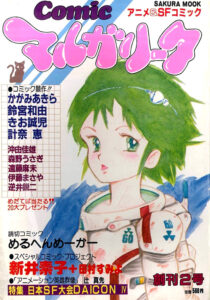 Daicon IV
Japan SF Convention Travelogue
Written by Revenge Company’s Kimitoyo Konno
Illustrations drawn by Beckoning Cat (Maneki Neko) ♡1
During my forth year after moving to Tokyo, I was part of the Japan SF Convention staff in Tokon 7 and 8, but this time around was my first experience as a regular attendee.
Upon arriving at the greatly anticipated Daicon IV venue, I was dumbfounded by the line extending all the way to the park besides the Welfare Pension Hall… Sigh. I was a little worried that if it was already this bad at 7:30, then it would become mass hysteria by the time the venue opens at 11:00. But as expected of Osakans, it opened more or less without a hitch. Usually the reception area gets pretty chaotic, but it seemed to go smoothly this time around.
And then to great applause, the screening of the anime opening began. There’s no way to put it other than indescribably mind blowing. I hope those of you who haven’t seen it yet get the chance to do so.
After the intermission, from 12 o’clock onward the overseas guest authors A. Bertram Chandler and Frederik Pohl greeted the audience. Looking around briefly, the huge crowds of people, which had even spilled out into the aisles, largely disappeared. As I checked the schedule lineup, it seems that people migrated over to some “bottomless Daicon game” being held at the sub-hall. It felt kinda disgraceful…
I figured I wouldn’t be able to get into the sub-hall, so instead I went over to the breakout sessions. All of the rooms were packed to the brim!2 I couldn’t move freely in the dealer’s room either. Once again, I felt the overwhelming force of the 4,000 attendees.3
I got so burned out by all the people that I went to the Great Hall to secure a seat and attend Noriaki Ikeda’s4 tokusatsu lecture. Even though I got there mid-way, I was still knocked away by this panel. You could feel the passion for tokusatsu behind each and every word uttered by Ikeda. I was relieved–the world of Japanese tokusatsu would be just fine as long as people like him are around.
After squeezing in another break, I went to the Seiun Award5 Ceremony. It felt more proper than usual. (Round of applause for Chōhei Kambayashi’s Kotobatsukaishi…6)
Then, I went to the dealer’s room again. I didn’t have time to pick out any books simply because I was too tired. I kinda wish they had separated the sale of merchandise entirely off into its own section.
After getting lunch, I returned to the Great Hall to listen to Sci-fi Music For You. Despite being warned repeatedly not to take flash photography, there were fans who did so without reservation. That aside, I was able to immerse myself in the fresh performances of Star Wars and the Akira Ifukube Suite.7
That concluded the line-up for day one. I finally headed toward the boarding houses, which one may even call the main attraction.
After dinner, I went back to my hotel in Sōemonchō.8 First I went to the SF-ism Room9 with the chief editor of the Masaki Yamada10 research group. After a delayed opening, I entered and paid one credit, basically to drink 100-yen sake and listen to conversations about author Shinji Kajio.11 But people flooded the room to full capacity, and I left shortly after, confounded.
Following that was the scheduled line-up at the training camp. I went over to the independent panel rooms, but I couldn’t enter them on account of the inner-circle aura. While wishing they were a bit more welcoming, I found myself with nowhere else to go. On a whim I decided to check out the room for next year’s SF Convention, Ezocon. There I received an extraordinarily warm welcome, and offered me plentiful amounts of food and drink as though I was a decade-long friend. Somewhat relieved, I chatted with next year’s executive committee chair about the SF Convention and SF doujinshi. I knew I could look forward to next year’s convention. As 12 o’clock rolled around, the Daicon staff came over, prompting outsiders to leave at once. Reluctantly, I went back to my hotel. I wanted to talk the night away, so I was a bit miffed at the overly rigid staff, but having been in their position before, I know very well how difficult it is, so I complied without fuss.
The next day, I went to the venue close to opening time, and yet again I was shocked by the long, winding line. The might of 4,000 people was appalling beyond imagination.
Yesterday, the sub-hall was extremely popular. Apparently the Miyauchi Hiroshi Show12 was especially so. Because of that, on day two I went to the sub-hall first. At (Good Morning Nice Daicon13), I watched GenePro’s Return of Ultraman. I tip my hat off to its intensity. Granted, it’s mimicking the directorial style of Akio Jissoji,14 but I was amazed by the high fidelity. However, what followed after the Daicon performer’s Ask me anything about scifi, the Amateur Filmmaker Grand Prize was so middling that it pissed me off. When compared to GenePro’s work, well, I feel somewhat sorry for them…
Then the Azicon I15 began, but all there was to see was an anime opening… Suffice to say, I got irritated mid-way and left.
I went back early to the great hall to secure a seat for the costume show. The Quiz Battle Royale was ongoing, but it was pretty dumb. Then after the third screening of the anime opening (strangely, they screened it three times — that in and of itself is amazing, but I felt like they overdid it) began the star of the SF convention: the costume show.
The grand prize winner of the competition, Keiō Uni’s Tōyama no Kei-san,16 was great, as was The Church of Perry Rhodan17 which caused a sensation in the sub-hall.
Apart from that, it felt just like an anime and tokusatsu convention.
And thus concludes the line-up scheduled for Daicon IV. Personally, I was really exhausted by the massive crowds. Between the mountains of people everywhere, there was no way to talk with friends or authors I only get to see at the SF Convention. By coincidence I entered an elevator with Motoko Arai,18 and I had the miserable experience of being accused of being a groper (by her “bodyguards”…). They’re free to accompany her, but I’d appreciate if they weren’t so unpleasant to others around them. It seems that a subset of fans mistook authors for media celebrities.
In some aspects, Daicon IV was received poorly; apparently the staff dealt with a bunch of issues with the fans. I don’t mean to protest against the entertainment aspect of Daicon, but it really feels like the attendees leaned too hard on that aspect.
After all the scheduled events, the teary-eyed executive committee chairman gave his closing remarks at the ending ceremony. I wonder how many people were touched by that even more so than the opening anime. I was deeply moved by the sight of everyone’s tears, which were likely also shed between sips of high-grade sake at the evening staff wrap-up party. That alone made it worth coming to Daicon IV.
Cheers to all the staff. Let’s meet again next year.
Writer’s Profile
Kimitoyo Konno. Seinor at Tokyo Metropolitan University. Member of the Scifi Research Club. Representative doujinshi: Commuter Rapid (通勤快速). Director of independent film Natto. Producer of Revenge Company, scheduled for release next time.
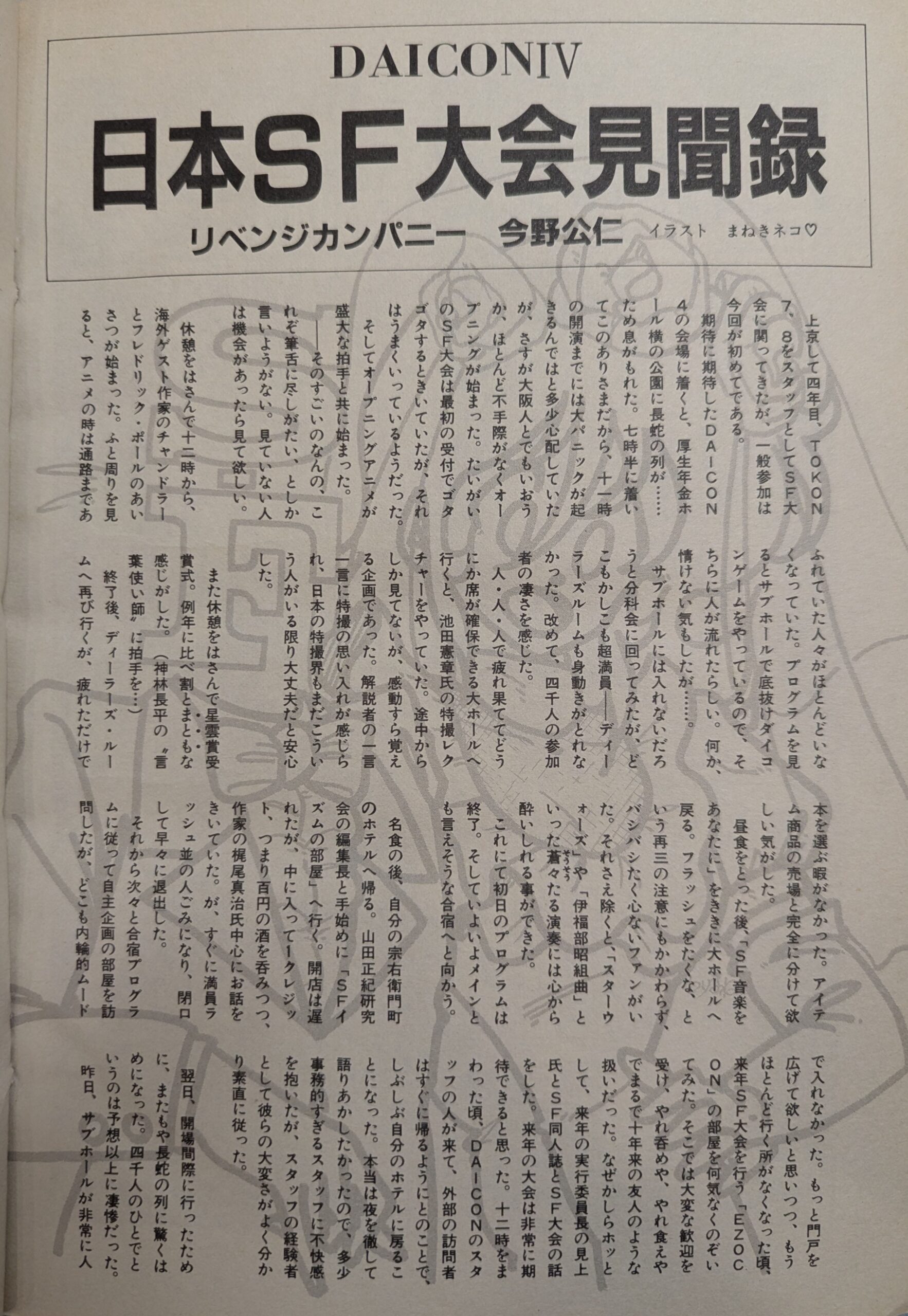
DAICONⅣ
日本SF大会見聞録
リベンジカンパニー 今野公仁 イラスト まねきネコ♡
上京して四年目、TOKON7,8をスタッフとしてSF大会に関わってきたが、一般参加は今回が初めてである。
期待に期待したDAICON4の会場に着くと、厚生年金ホール横の公園に長蛇の列が……ため息がもれた。七時半に着いてこのありさまだから、十一時の開演までには大パニックが起きるんではと多少心配していたが、さすが大阪人とでもいおうか、ほとんど不手際がなくオープニングが始まった。たいがいのSF大会は最初の受付でゴタゴタするときいていたが、それはうまくいっているようだった。
そしてオープニングアニメが盛大な拍手と共に始まった。
⸻そのすごいのなんの、これぞ筆舌に尽くしがたい、としか言いようがない。見ていない人は機会があったら見て欲しい。
休憩をはさんで十二時から、海外ゲスト作家のチャンドラーとフレドリック・ポールのあいさつが始まった。ふと周りを見ると、アニメの時は通路まであふれていた人々がほとんどいなくなっていた。プログラムを見るとサブホールで底抜けダイコンゲームをやっているので、そちらに人が流れたらしい。何か、情けない気もしたが……。
サブホールには入れないだろうと分科会に回ってみたが、どこもかしこも超満員⸻ディーラーズルームも身動きがとれなかった。改めて、四千人の参加者の凄さを感じた。
人・人・人で疲れ果ててどうにか席が確保できる大ホールへ行くと、池田憲章氏の特撮レクチャーをやっていた。途中からしか見てないが、感動すら覚える企画であった。解説者の一言一言に特撮の思い入れが感じられ、日本の特撮界もまだこういう人がいる限り大丈夫だと安心した。
また休憩をはさんで星雲賞受賞式。例年に比べ割とまともな感じがした。(神林長平の ”言葉使い師” に拍手を…)
終了後、ディーラーズ・ルームへ再び行くが、疲れただけで本を選ぶ暇がなかった。アイテム商品の売場と完全に分けて欲しい気がした。
昼食をとった後、「SF音楽をあなたに」をききに大ホールへ戻る。フラッシュをたくな、という再三の注意にもかかわらず、バシバシたく心ないファンがいた。それさえ除くと、「スターウォーズ」や「伊福部昭組曲」といった蒼々たる演奏には心から酔いしれる事ができた。
これにて初日のプログラムは終了。そしていよいよメインとも言えそうな合宿へと向かう。
名食の後、自分の宗右衛門町のホテルへ帰る。山田正紀研究会の編集長と手始めに「SFイズムの部屋」へ行く。開店は遅れたが、中に入って1クレジット、つまり百円の酒を呑みつつ、作家の梶尾真治氏中心にお話をきいていた。が、すぐに満員ラッシュ並の人ごみになり、閉口して早々に退出した。
それから次々と合宿プログラムに従って自主企画の部屋を訪問したが、どこも内輪的ムードで入れなかった。もっと門戸を広げて欲しいと思いつつ、もうほとんど行く所がなくなった頃、来年SF大会を行う「EZOCON」の部屋を何気なくのぞいてみた。そこでは大変な歓迎を受け、やれ呑めや、やれ食えやでまるで十年来の友人のような扱いだった。なぜかしらホッとして、来年の実行委員長の見上氏とSF同人誌とSF大会の話をした。来年の大会は非常に期待できると思った。十二時をまわった頃、DAICONのスタッフの人が来て、外部の訪問者はすぐに帰るようにとのことで、しぶしぶ自分のホテルに戻ることになった。本当は夜を徹して語りあかしたかったので、多少事務的すぎるスタッフに不快感を抱いたが、スタッフの経験者として彼らの大変さがよく分かり素直に従った。
翌日、開場間際に行ったために、またもや長蛇の列に驚くはめになった。四千人のひとでというのは予想以上に凄惨だった。
昨日、サブホールが非常に人気があった⸻特に、「宮内洋ショー」はすごかったらしく、そこで2日目は、始めからサブホールへ行ってみた。(おはようナイスダイコン)で、ゼネプロの「帰って来たウルトラマン」を観た。その迫力には頭が下がった。実相寺の演出の真似とはいえ、ハイレベルであるのにはびっくりした。しかし、ダイコン芸人による「SF何でも聞いたってや~」の次の「AFM大賞」のレベルの低さにはいい加減、頭にきた。まあ、ゼネプロ作品と比べたら可哀想かもしれないけど……。
続いて「AZICONⅠ」が始まったが、それはオープニングアニメしか見るところはなかった……といっても、途中で嫌になったから出て行ったのだが。
コスチュームショーの席取りをかねて大ホールに戻ると、「クイズ・バトルロイヤル」をやっていたが、あほらしかった。三度目のオープニングアニメ(不思議な事だが、オープニングアニメを三度もやったのだ⸻確かにそれ自体はすごいと思ったが、やりすぎだと感じた)をはさみ、SF大会の花、「コスチュームショー」の開幕。
大賞を獲得した慶応大の「遠山のケイさん」やサブホールでも一大センセーショナルを巻き起こした「◯ペ教」が良かった。
他はまるでアニメ・特撮大会のように感じた。
こうしてDAICON4のプログラムは終了したのであるが、個人として思うには、人の多さにはかなり疲れた。どこもかしこも人の山で、SF大会でしか会えない友人や作家と話すどころではなかった。新井素子と、たまたまエレベーターでいっしょになったら痴漢扱いされたりして(もっともその親衛隊にであるが)ひどい目に会った。ついて歩くのは勝手だが、周囲に不愉快だけは与えてほしくない。
何か、一部のファンは作家とタレントをカン違いしているようにも思える。
色々な意味で不評であったDAICON4であるが、大会スタッフ側より、ファンの側に相当の問題がありそうだ。DAICONのエンターティメントに反対するつもりはないのだが、受け手側がそれに甘えすぎている気がしてならない。
全スケジュール終了後に、エンディングで涙ながらにあいさつした実行委員長の言葉に、オープニングアニメ以上に感動した人間はどのくらいいただろう。
今回のスタッフの、打ち上げの夜の美酒と、その席で多分流されただろう涙が実感としてひしひしと伝わってきた。
それだけでもDAICON4に来てよかったと感じられた。
スタッフのみなさん、御苦労さまでした。来年また会いましょう。
<おわり>
筆者プロフィール
▶ 今野公仁 東京都立大四年生同大SF研所属。同人誌 ”通勤快速” 代表。自主映画 ”NATTO” の監督でもある。次回登場予定の ”リベンジカンパニー” のプロデューサーも努めている。
Notes
- See illustrations behind the text as printed in Comic Margarita pages linked above the Japanese text.
- At Daicon III, the rooms for breakout sessions would seat tens of people. It’s unclear if that was the case for Daicon IV as well.
- The attendance of the Japan SF Convention peaked with Daicon IV at around 4000 people, but since then it has basically hovered between 1000-2000 or fewer people.
- Noriaki Ikeda was a film critic, lecturer, editor, and producer. He contributed articles to tokusatsu magazine Uchuu-sen (Spaceship), anime magazines Animage and Animec, sci-fi magazine Starlog, and others.
- The Seiun Award is an annual award given to the best sci-fi works of the previous year. Winners are selected by fan voting at the Japan SF Convention.
- Chōhei Kambayashi did in fact win the Seiun Award in the short story category for Kotobatsukaishi. His novel Yukikaze is his most well known work to English-speaking audiences, and it has been translated and released officially in English. Yukikaze has also been adapted into anime as an OVA.
- Akira Ifukube was the composer of many pieces for Godzilla.
- Sōemonchō is an entertainment district with a high concentration of bars, restaurants, and nightclubs.
- SF-ism was a sci-fi magazine that lasted 16 volumes along with some supplementary volumes, one of which was entirely about sci-fi writer Arai Motoko who is mentioned later in this report. Scans of SF-ism‘s own reports on Daicon III and IV can be found on the Daicon Archives tumblr.
- Masaki Yamada is a Japanese crime and science fiction author, who has won the Nihon SF Taisho award, and the Seiun Award three times.
- Shinji Kajio is a sci-fi and fantasy author and won the Nihon SF Taisho Award in 1991. He’s also the writer of the manga series Emanon which was released in English by Dark Horse.
- Quoting the English wikiepdia article, “[Hiroshi Miyauchi] is best known for playing some of the most memorable roles in Tokusatsu history, such as Akira Shinmei/Aoranger in Himitsu Sentai Goranger, Soukichi Banba/Big One in the Sentai series J.A.K.Q. Dengekitai, Chief Councillor Naoyuki Miura in Chouriki Sentai Ohranger, Shiro Kazami in Kamen Rider V3 (in which he also sang the opening theme for) and Ken Hayakawa in Kaiketsu Zubat.”
- Good Morning Nice Daicon (おはようナイスダイコン) was likely a parody of the talk show Good Morning Nice Day (おはよう!ナイスデイ), An excerpt can be found on YouTube.
- Quoting the English wikipedia article, “Akio Jissoji was a Japanese television and film director best known outside Japan for the 1960s tokusatsu TV series Ultraman and Ultraseven, as well as for his auteur erotic ATG-produced Buddhist trilogy Mujo (無常), Mandala (曼陀羅), and Uta (哥).”
- Azicon I was one of the events held at Daicon IV. The main attraction was the anime opening featuring characters from famed disappearing-diarist Hideo Azuma’s work. The anime opening for Azicon I was a co-production between two fan clubs: Studio Rami and Shippo Ga Nai (No Tail). This opening can be found on YouTube. There was an Azicon II at Ezocon 2 in Hokkaido, but it was just the production and sale of merch.
- Tōyama no Kei-san (遠山のケイさん) was probably a cosplay parody of Tōyama no Kin-san. The ongoing TV adaptation during the time of the event would be that which starred Hideki Takahashi, 1982-1986, as noted on the Wikipedia article. This is a period drama, which strikes me as being the complete opposite of sci-fi, but maybe the parody aligned more with the convention’s theme.
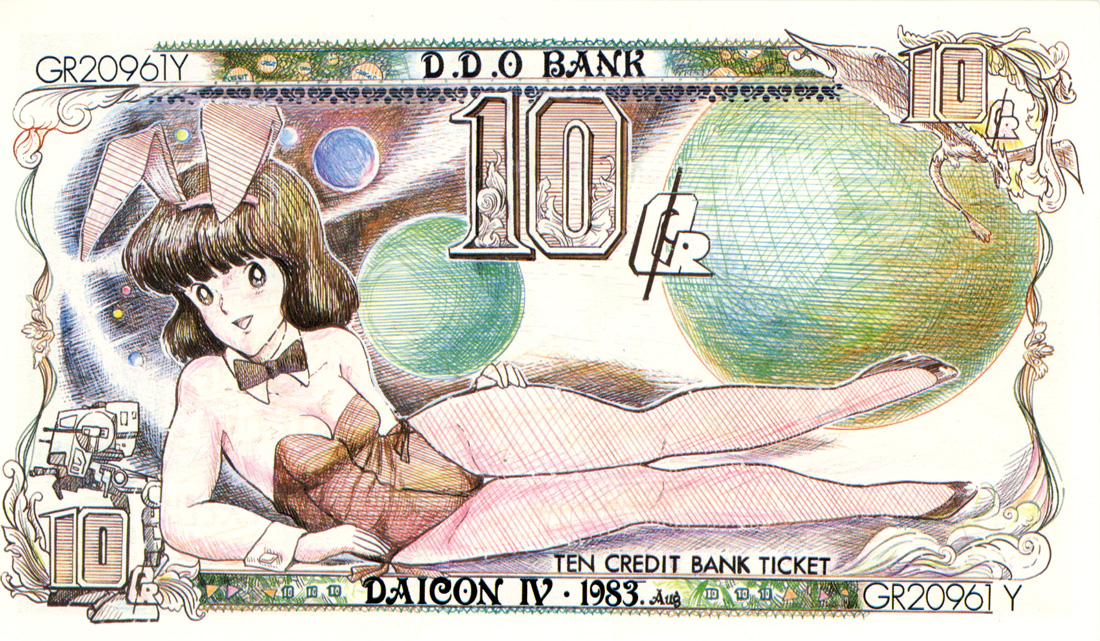
- Perry Rhodan is a German space opera series which was popular in Japan. It also had a notable presence at Daicon IV in the form of not only events but also fictional currency: Perry Rhodans. You could exchange yen for them at the currency exchange booth as follows:
Yen Credits Perry Rhodans 50 5000 100 1 10000 500 5 1000 10 The 5000 Perry Rhodan bill was the smallest denomination of the fictional currency used, and it was treated like half a credit (i.e. used as change). A picture of all the fictional currencies can be found here.
- Motoko Arai was a very popular sci-fi author in the 80s. At the time of Daicon IV she was 23 years old, but she was first catapulted into stardom in her second year of high school as one of the honorable mentions of the first Kisō Tengai (a sci-fi magazine) Newcomer Sci-Fi Award. A manga adaptation of her short story Kage-e no Machi ni te was featured in Comic Margarita Vol. 2, from which this Daicon IV report is sourced.