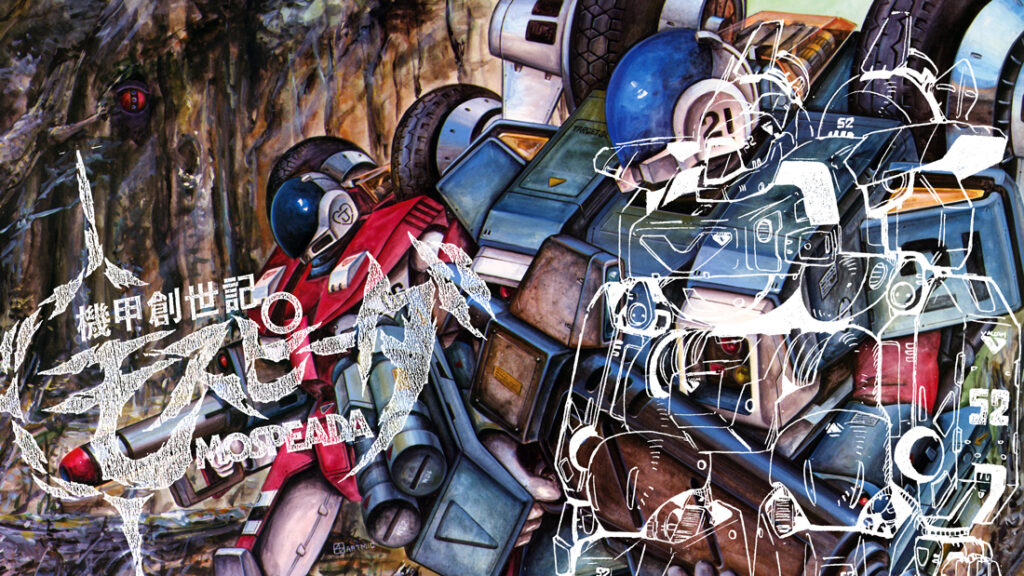
Of all the robot shows that hit airwaves during the explosion of mecha shows in the early 1980s, Genesis Climber Mospeada stands out as something unique. It wasn’t a massive hit and arguably achieved greater notoriety overseas thanks to its use in Robotech, but Mospeada approached the mecha genre in ways its peers didn’t. Part war story, part Western, Mospeada suffered as a production pulled in two directions and from the occasional bout of poor animation, but somehow, managed to be more than the sum of its parts.
When Mospeada hit airwaves on October 2, 1983. The design studio behind it, ARTMIC, had an uneven pedigree. The studio’s origins lay in a company called Wiz Corporation, a Tatsunoko subcontractor founded by an ex-Tatsunoko producer named Toshimichi Suzuki and his associate Yutaka Murakami. Wiz worked with toy sponsors as a liaison between studios and sponsors.
In 1978, Wiz began working on Techno Police 21C, a TV show that was to be sponsored by toy manufacturer Tomy using designs from the legendary Studio Nue. In what could best be described as “development hell” Techno Police 21C never reached airwaves as intended and instead emerged, a bit worse for wear, as an 80-minute “pilot” film in 1982. In the midst of that project, Wiz and Studio Nue began to collaborate on a new TV series in 1980. This new project, first envisioned as a sci-fi sendup, would go through numerous iterations before finally premiering on TV in October 1982 as the seminal Super Dimension Fortress Macross. But Wiz’s involvement quickly faded and by the time Macross entered pre-production, Suzuki’s company was no longer involved.
While Macross and Mospeada weren’t directly related, there were connections. Many of the staff from Techno Police would later work on one or both of the two series. Macross was a Studio Nue project that had Techno Police alums Kazutake Miyatake, Shoji Kawamori, and Kenichi Matsuzaki as driving creatives behind it. On the Mospeada side, both Techno Police’s character designer Yoshitaka Amano and composer Joe Hisaishi reunited with Suzuki for Mospeada.
The details of when, how, and why Wiz became ARTMIC aren’t well documented—even accounts written by ARTMIC staff vary a bit, but the important thing to mention is that with Studio Nue working on Macross, if Suzuki was going to produce a new TV show he’d need new designers. Enter Hideki Kakinuma and Shinji Aramaki. It just so happened that the young duo did more than mechanical design and had a pitch for a new robot show ready to shop around to sponsors. This new series, Genesis Climber Mospeada, would premiere almost a year to the day after Macross did and set the foundation for ARTMIC’s animation work for the next decade.
The Lonely Soldier Boy
While most robot anime of the gunpla boom focused on interstellar warfare or invading hordes of aliens, Mospeada skipped all that and went right for the aftermath of global war. Even before the first episode of the series begins, an alien species called the Inbit have attacked Earth, won, and occupied the planet. With humans on Earth suffering under their new alien overlords, the last enclaves of free people exist on colonies scattered around the solar system on Mars, Jupiter, and the Moon. Those colonies begin to launch attacks to retake Earth from the Inbit, and it’s the second attempt to retake Earth that occurs in the opening scenes of the first episode of Mospeada.
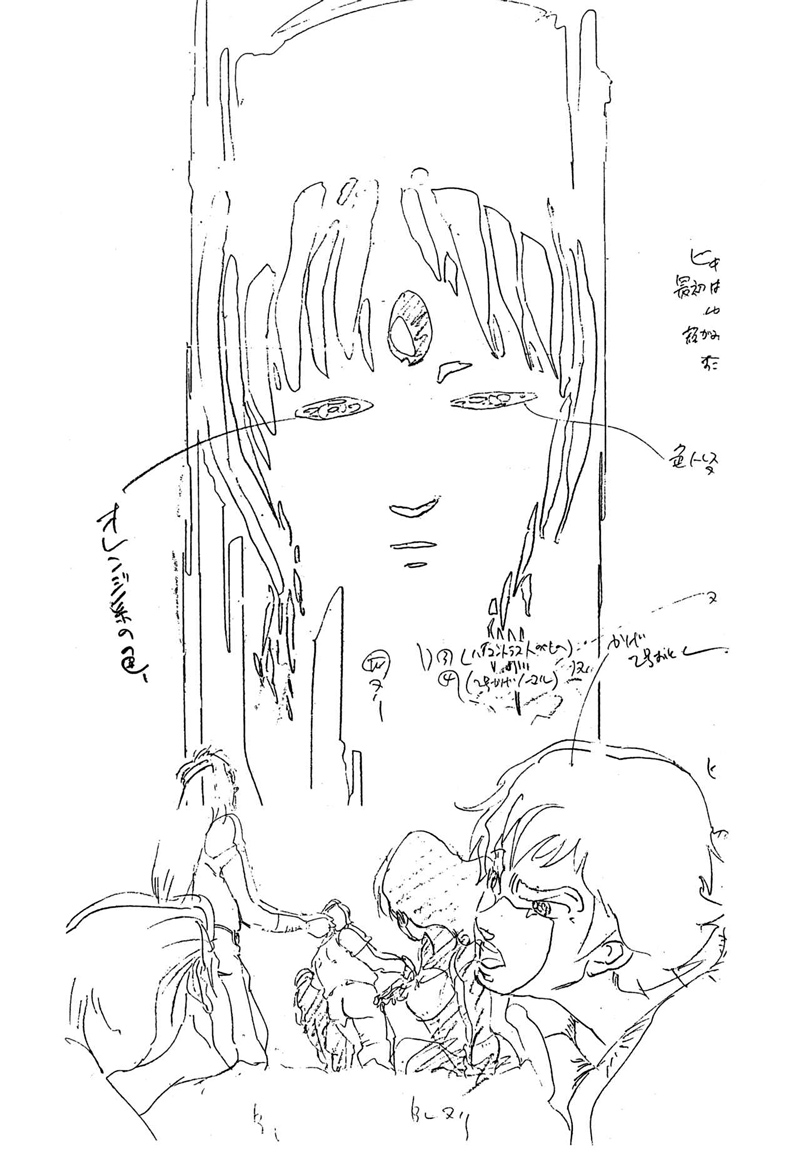
Mars Base soldier Stick Bernard is one of the few survivors of this second assault and soon finds himself alone in the unknown wilderness of South America with a single mission: Meet any survivors at the Inbit headquarters of Reflex Point for a final assault to drive them off Earth. Along the way, Stick assembles a ragtag crew of survivors and former soldiers to accompany him. Among them is Ray, a young scavenger; Mint, a young girl obsessed with finding a husband; and Houquet, a former biker girl1 They’re joined by Yellow, a former soldier-turned-singer who dresses as a woman on stage, and Jim a former soldier wrestling with his past. Later a trio of humanoid Inbit characters begin showing up, one of whom, Aisha, joins Stick’s group while another, Solzie, ends up becoming the Milia to Yellow’s Max.
Screenwriter Sukehiro Tomita drew another parallel between Macross and Mospeada when describing the design of Houquet, saying, “In terms of Houquet, back on Macross, [Haruhiko] Mikimoto referenced Seiko Matsuda when drawing Minmei. In kind of the same way, I told [Yoshitaka] Amano to think of a kind of delinquent version of Akina Nakamori2 when designing Houquet. He seemed to get what I was going for.” For Mint, Tomita took a different approach, trying to create a character that resonated with kids, saying, “I wanted to make a character that would match the Fuji TV house style, or, in other words, to create a character that would be a hit with ‘normal’ kids.”
With each episode mostly serving as a stand-alone story, Mospeada’s overarching narrative sputters along, at times either seemingly forgotten or hurriedly trying to cram in way too much. It’s not until the show’s second half that things start to build momentum but even then that momentum occasionally disappears as the characters meander through a particular encounter that seems largely irrelevant to their final goal. The downside of this is that character relationships seem to phase in and out of relevancy, but once the human-looking Inbit characters show up, far too much is crammed into too few episodes. The show’s final episodes are particularly guilty of this as they’re packed full of exposition and character development that doesn’t necessarily feel rushed, but does leave you wondering why it hadn’t been doled out across the earlier twenty or so episodes.
The show was clearly intended to last longer than it did, and when the order came down to wrap it up, it was abrupt and unexpected. Tomita explained:
“When I was working on episode 21 or so, I got the word that we’d have to wrap it up in another 3 to 4 episodes. I’d been told we’d have at least three cours to do the series, so my thought was, ‘wrapping it up that quickly? What a joke.‘”
Had the series been able to run its intended length, Tomita thought that the ending would have been handled better and with a bit more intensity, saying:
“The ending would’ve lasted 5 to 6 episodes. The Inbit attack would’ve become more and more brutal, and the protagonists would’ve had to overcome those obstacles. I think we would’ve been able to better depict the severity of that situation.”
For full translations of interviews with Hideki Kakinuma and Sukehiro Tomita, join our Patreon for access to those and other translated materials.

Mospeada Genesis
The story of Mospeada’s production began in the early ‘80s and eventually combined elements of disparate projects and ideas into one show. In its earliest iteration, Mospeada was a war story in the vein of Robert A. Heinlein’s Starship Troopers, focused on the exploits of futuristic soldiers sent to reclaim Earth from alien invaders. Early working titles included Descent Machine Vector and Super Immortal Fortress Reflex Point.3 Clearly inspired by Starship Troopers, the original outline didn’t have the invasion to liberate Earth occur until halfway through the series—the first half of the show was to follow the training regimen of soldiers on Mars as they worked to prepare themselves for the environments of Earth. By the time the show entered production, though, that pivotal invasion had been moved to the first episode.
That the original pitch for Mospeada seemingly drew so heavily from Starship Troopers also opens another parallel to the famed Studio Nue, as members Naoyuki Kato and Kazutaka Miyatake penned a foundational powered suit design for the Japanese version of the novel.
Raised on war movies from the ‘60s and ‘70s, Kakinuma and Aramaki had originally intended the story to be a sci-fi retelling of the D-Day landings in Normandy. This was at odds with what Suzuki, scriptwriter Tomita, and producers at Tatsunoko wanted, however, as they pushed for more of a sci-fi western. Kakinuma attributed this to generational differences; the older generation (Suzuki, Tomita) raised on westerns butting heads with the younger generation (Kakinuma, Aramaki) raised on war movies. Kakinuma and Aramaki’s original pitch had mechanized infantry moving across Earth, liberating territory from the aliens along the way toward their headquarters, a la Allied forces moving across western Europe in World War II. While the protagonists would be from Mars, retaking Earth was actually a combined effort of various colonies scattered around the solar system, with soldiers from colonies like Jupiter also taking part. This naturally reinforced the D-Day metaphor, as disparate groups joined together for a single offensive push.
The influence of those wanting a western feel tweaked this plan to be more akin to what Kakinuma described as a “horse opera” comparable to Steve McQueen’s Wanted Dead or Alive, with heroes moving from town to town. The general concept of heroes moving across enemy territory towards the alien headquarters remained, but the scope and style was different. Regarding the change, Kakinuma described it saying, “The formula [was] similar, but [was] completely different.” Such was the shift from the original plan, that scriptwriter Tomita later admitted to not even knowing that Aramaki and Kakinuma were the original creators of the series, saying, “They hardly participated in the script meetings, so I assumed they were just the mechanical designers. As the show’s creators, I’m sure they had various opinions about things like the story and the taste of the series, and I think they were kind of embarrassed by the fact they weren’t able to voice those opinions during the production.”
The world that the protagonists explored in Mospeada was one of vast wilderness, sparse civilization, and no large government, leaving the heroes to regularly contend with corrupt city officials or local warlords. It was a world of independent cities and hardscrabble people struggling to get by under the distant, but constant, supervision of the Inbit. In other words, it was the Wild West with alien overlords.
Sometimes that influence was more obvious than others. For example, in episode 17, “Old Soldier’s Polka,”4 the inhabitants of a city rebuilt in a giant blast crater are described by Stick as having “the frontier spirit of the first settlers.” Our heroes are held at gunpoint by the town’s sheriff wielding a giant revolver and then housed in his jail cell, straight out of a black and white Western. A later scene involving two masked figures on horseback is described by characters onscreen as like “a Western movie.” Not all episodes wore their influences so prominently on their sleeve, but that Western aesthetic is impossible to miss throughout the entire series and features prominently in the clothing style and town design of many episodes.
Most giant robot shows of the era had some sort of explanation for the immense power required to power mecha (Minovsky particles in Gundam, Over Technology in Macross), Mospeada forced Kakinuma and Aramaki to go further and consider not just what powered the machines but how universal those energy sources might be. In a traditional war story, with bases and resupply logistics, background details like that wouldn’t really be a concern, but in the hinterlands of Mospeada they needed to explain how human technology relied on a single source of power that could be interchangeably used by both mecha and handheld weapons (in Mospeada, this fuel was called HBT). Additionally, they had to take into consideration that the heroes would need to spend time making sure they had enough fuel to keep moving. This forced them to focus not just on fighting the alien Inbit, but also scavenging for supplies. Winning wasn’t always the objective in Mospeada, sometimes they were just trying to get enough supplies to make it to the next town.
While the original “sci-fi D-Day” angle was diluted as pre-production continued, at least one obvious aspect of this version made it to the final show: the black and white “invasion stripes” visible on the wings of Legioss fighters were identical to the markings used on Allied aircraft. That this very early concept survived to production was thanks to Aramaki and Kakinuma having final control over the colors of the mecha. Had the series been successful enough to run longer than it did, the World War II analogies would have been a bit more obvious. Kakinuma wrote in ARTMIC Design Works that had the series lasted longer, it was planned that the setting would have changed from the Americas to Europe, with Stick’s group fighting battles in locations known for World War II battles like Dunkirk and the Ardennes.
Mospeada Staff
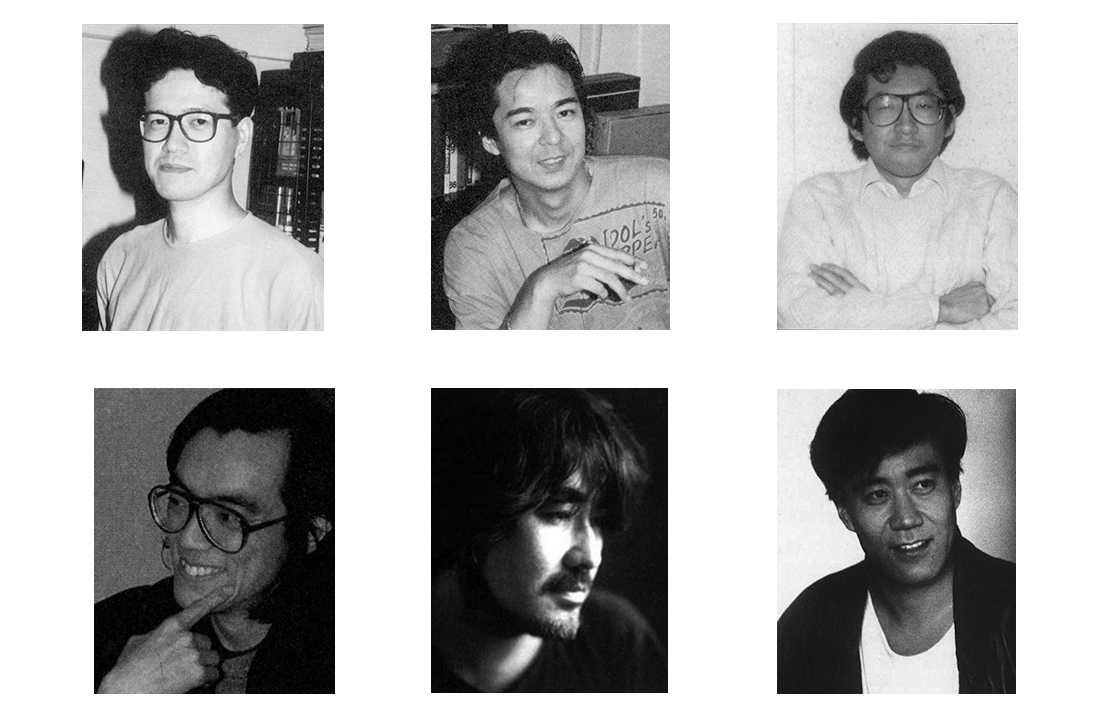
The staff assembled for Mospeada was composed of an interesting mix of newcomers, familiar faces from Techno Police 21C, and a few staff from Macross—a reminder that the connection between Macross and Mospeada ran through much of the series’ production history, albeit indirectly.
While Kakinuma and Aramaki put together the initial pitch for Mospeada, Suzuki and Tatsunoko producers had a hand in the plotting of the series. The series would also reunite two staff from Techno Police; composer Joe Hisaishi and character designer Yoshitaka Amano. The role of Chief Director was given to Katsuhisa Yamada in his first such role, while a little over a third of all the show’s episodes were written by Sukehiro Tomita, who worked on many Macross episodes as a scenario writer. Ryo Yasumura, who worked on scripts, storyboards and even as episode director for a couple of episodes of Mospeada, worked on Macross in similar roles, albeit under the pseudonym Shoichi Yasumura. Key animator Hiroyuki Kitakubo, storyboard and episode director Katsuhito Akiyama, and episode director Tatsuya Kasahara were some of the other Macross veterans who worked on Mospeada. Legendary animator Yoshinori Kanada animated the opening.
Joe Hisaishi’s work on Mospeada came at around the same time he produced an image album for Hayao Miyazaki’s Nausicaä manga in 1983. He was later tapped to work with Miyazaki on the film adaption and went on to score nearly all of the legendary director’s films. Similarly, Yoshitaka Amano would become famous thanks to his work on the Final Fantasy video game series that began in 1987. These days, Mospeada is rarely mentioned when either Hisaishi or Amano’s work gets discussed, but their involvement underlines the fact that some seriously talented people worked on the series.
Frontier Freedom Fighters
While Mospeada may have bucked the trend of traditional giant robot warfare by focusing on a scrappy bunch of fighters forced to scavenge for supplies and food, the mechanical designs were very much on-trend, albeit with a twist. The addition of transformable aircraft into the mix was done at the behest of sponsor Imai, a small model kit manufacturer that had previously found success with the transforming Valkyries of Macross. Imai, along with Nichimo and Arii, had combined their efforts to give Macross a surprising amount of model kit support, comparable to what “big” model kit companies like Bandai or Takara were rolling out for their shows. For Mospeada, Imai was going it alone but clearly banked on more transforming robots being the secret to more success.5
But while there had been plenty of variations of the VF-1 Valkyrie, there was ultimately just one transformable robot at the core of many of those Macross kits, and so it’s not surprising that Imai6 insisted on including a range of transforming vehicles in Mospeada. That’s why the Legioss’ booster, the Tread, also transformed.7 And it’s why the scope of the show was expanded to include the transforming Ride Armor motorcycles it’s best known for, although doing so caused some issues from a creative point of view.
In an interview published in Great Mechanics DX3, Kakinuma explained:
But that left us with a glaring plot hole: Why travel by motorcycle when they have high-speed jets? That really got to us. Since the sponsors were insistent that we showcase multiple models of motorbikes and fighter planes, we had to figure out the best way to utilize them in the show. From a creator’s lens, the show is full of contradictions, but the casual viewer doesn’t care about things like that.
The show’s transforming motorcycles made their way into the initial pitch to sponsors after being borrowed from a side project Aramaki was working on with a police focus, although contrary to the long-held belief that the designs were pulled from a specific project, it was more of a design that Aramaki was working on for a type of show rather than a specific show. As Aramaki explained to me, “I always say that I designed the mecha of the Mospeada for another project which is about future police force, but I did not have a specific plan for such a project at that time. I made the first rough design because I thought that kind of mecha would be suitable for that kind of anime project.”
It’s worth pointing out that ARTMIC had more than a few ideas for shows based on futuristic police being developed at different stages; perhaps the best documented was Gyro Fungus. Described as being “halfway between Techno Police and Bubblegum Crisis,” Gyro Fungus would have focused on the AD Police as they cracked down on androids that disguised themselves as human. Hideki Kakinuma insisted in ARTMIC Design Works that the idea for the show was created before Blade Runner hit theaters.
While the Ride Armor wouldn’t appear in a police anime, its inclusion in Mospeada launched a long-standing ARTMIC tradition: the transforming motorcycle. Most notably seen in two of the studio’s most beloved OVAs, Megazone 23 and Bubblegum Crisis.
In ARTMIC Design Works, Aramaki wrote that he attempted to make a papercraft model of the Ride Armor to demonstrate the transformation sequence. When that didn’t work out, he turned over his drawings to a fellow student who was the son of a boat carpenter and skilled with wood. This craftsman managed to turn Aramaki’s designs on paper into a transforming model in just three days. That same model was then used when Aramaki presented the design to Tatsunoko.
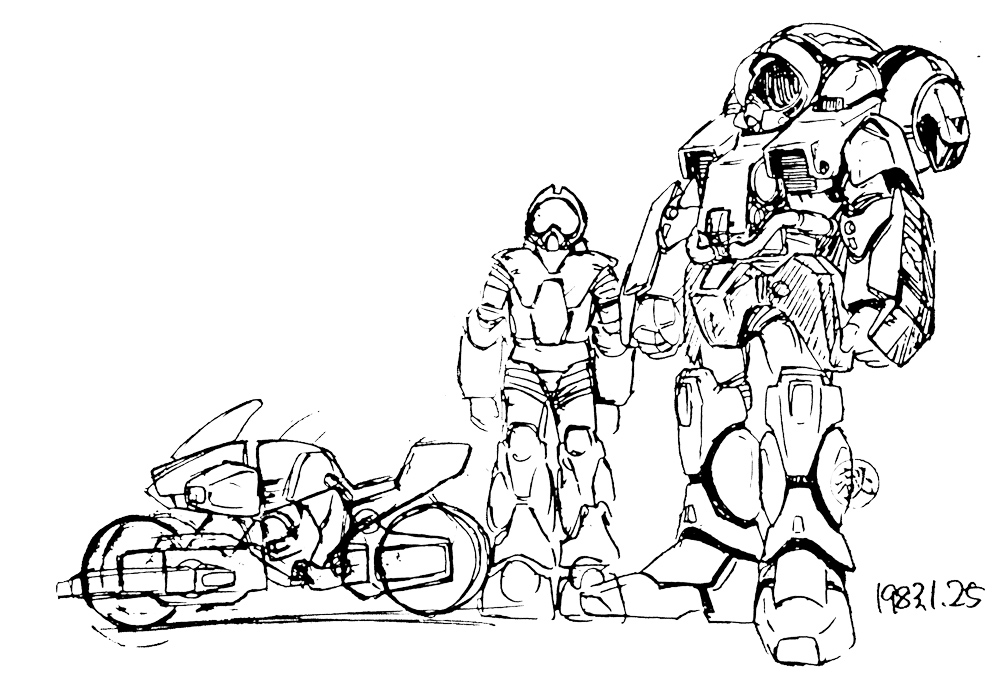
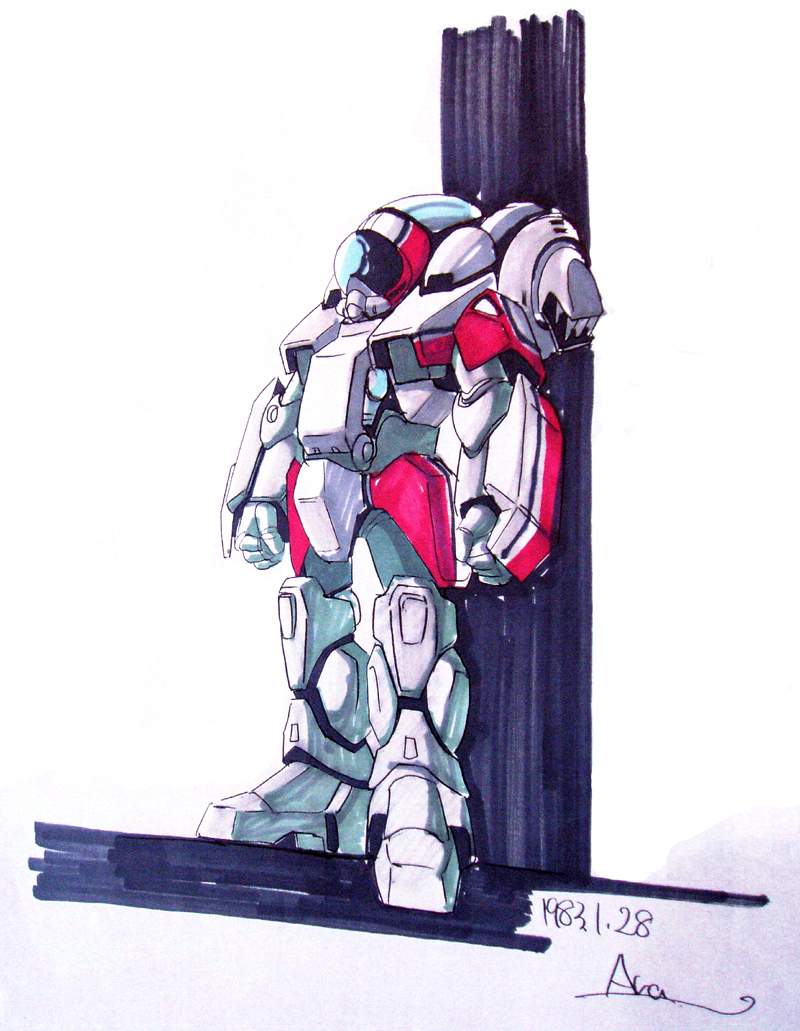
One of the earliest designs attached to what became Mospeada was the “Valcom,” a blocky powered suit that Aramaki drew in October 1982. Seemingly non-transformable, it’s likely that this early design was a part of the plan Kakinuma and Aramaki had pitched early on, when the show was to have focused on soldiers in powered suits slowly liberating Earth.
The show’s primary transformable fighter, eventually called the “Legioss,” went through numerous revisions in the early months of 1983, with both Aramaki and Kakinuma taking turns nailing down the look. Early versions from mid-February refer to these proto-Legioss designs as alternatively “Vector” or “Super Vector.” Judging by the dates on most of these early concept sketches, the basic shape and look of the Legioss seems to have been decided by late February 1983, although it still had a ways to go. As late as the end of April 1983, despite the design being recognizable as a Legioss and even paired up with a transforming booster called a Tread, concept art sketches for the transforming fighter were using both the name “Vector” and “Legios.”
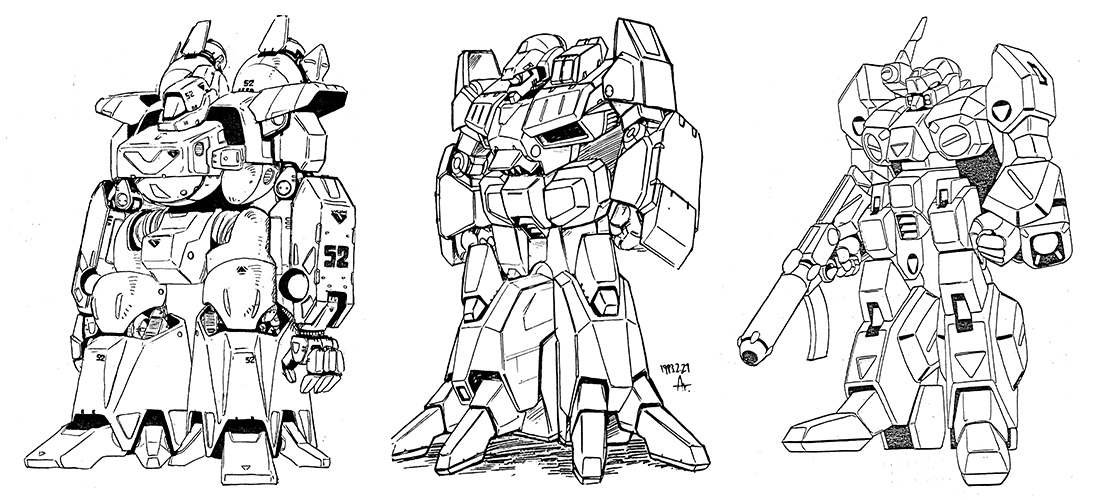
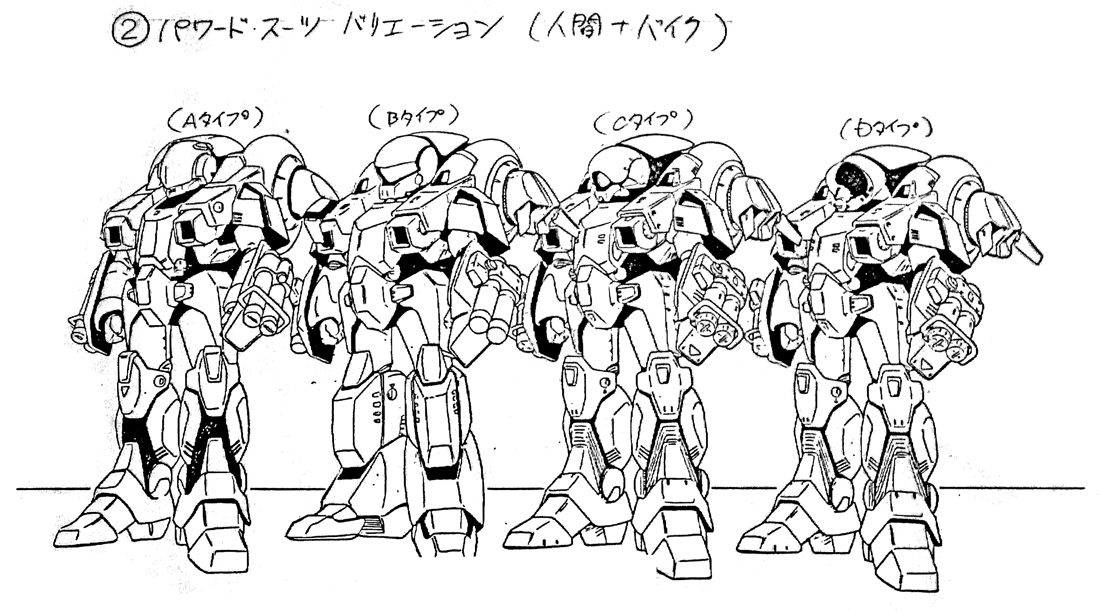
Concept art for Mospeada, uncovered decades later in a box of materials once belonging to Imai, revealed that much more than what appeared on screen was prepared in anticipation for the new series, some of it perhaps intended for the aforementioned settings of Europe. Aramaki and Masayoshi Kubota8 developed a number of different concepts for the Ride Armor, including a “Moto-Spider”9 mode with spatchcocked wheels-turned-hover-jets, and a variety of alternative designs that bore more resemblance to scooters or hoverbikes than the final Ride Armor bike mode. Designs were also drawn up for a variety of helmet and armor styles (with the full face screen seen in Mospeada being labeled as the “A type”), and some heavier armed Ride Armor variants that were being finalized in November 1983, about a month after the show had made its debut on TV screens.
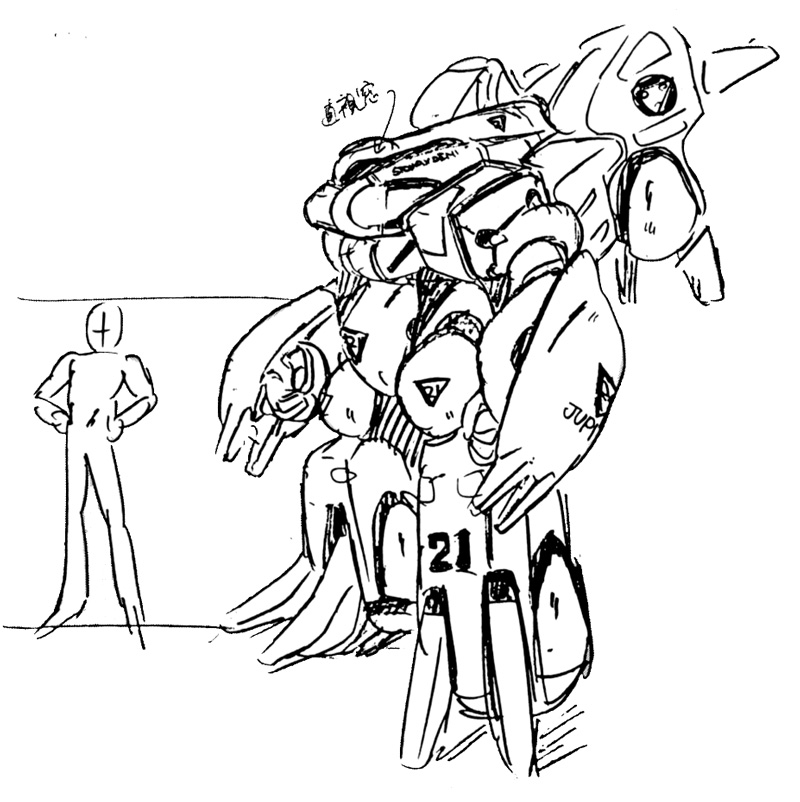
A variety of heavier, mostly non-transformable mecha (the Mospeada equivalent of Macross’ Destroids) look to have been designed in June of 1983, with some other never-animated designs getting sketched in November of that year. My (purely speculative) guess regarding these heavier armed Legioss and Ride Armor variants getting drawn up after the show had begun airing is that they had been planned for a late-series reveal, perhaps as part of the 3rd Liberation Force that arrives during the show’s final episodes.10 Whatever the circumstance, it seems clear that the staff and/or sponsors behind Mospeada had hoped to include a wider variety of mecha in the show or broader merchandising. In the ARTMIC Design Works, a rough sketch of an early Jupiter Base armored suit is shown and labeled as a unit that was used by the First Liberation Force, with a note that similar, less-prominent mecha had been planned to be included in the final show.
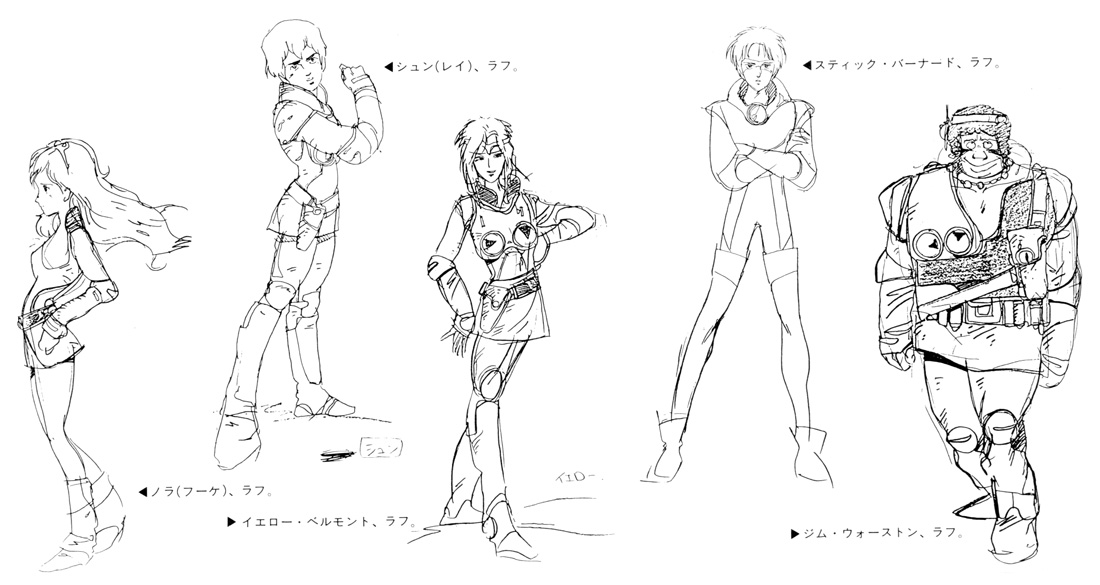
While not as well documented as the pre-production mechanical design process, sketches in ARTMIC Design Works (almost certainly by Yoshitaka Amano, but not explicitly labeled as such) showed early designs for characters like Stick, Houquet (originally named Nora), and Ray (originally named Shun), in garb that looked decidedly different than their final onscreen appearance. Their outfits looked less mundane, but in that classic Amano style; they probably could have been labeled as appropriate for both “sci-fi” and “fantasy” settings.
Life After Reflex Point
Despite having some planning for a longer run, Mospeada ended with its 25th episode. Its story wasn’t over, though.
In September 1985 a direct-to-video sequel to the TV series was released as part of the first wave of OVA projects, although Live Love Alive was less an all-new story and more compilation film and music video. At roughly the same time in the United States, Harmony Gold was selling Robotech to TV channels across the country, and Mospeada made up the third chapter of a series that also used Macross and Southern Cross.
It could be easy to reduce Mospeada‘s legacy to that of one born out of its use in Robotech, but the show was clearly more than that. At a time when robot anime on TV was trying every possible angle to capture some of that Gundam magic, Mospeada did things its own way. The charm of its original characters and story still endures and its designs have stood the test of time; nearly 40 years on and we’re still seeing new Mospeada toys and models. In fact, thanks in part to a revival sequel series called Genesis Breaker that ran in the pages of Hobby Japan, and new toys and models from Takara Tomy, Pose+, and Good Smile Company, Mospeada feels very much like it’s still alive. That the series and designs it featured have endured so well, and so much longer than many of its gunpla boom peers, speaks not just to the quality of the show, but to the talents of all the people who worked on it behind the scenes.
Portions of this article previously appeared in the ARTMIC Fan Book.
Special thanks to Shinji Aramaki, Roger Harkavy, and Kyoug.
Translations by Matt Schley and Maude Duke.
Sources
- Great Mechanics G, Winter 2023. Interviews with Sukehiro Tomita and Hideki Kakinuma.
- Great Mechanics DX 3 (December 2007). Interview with Hideki Kakinuma.
- ARTMIC Design Works
- Entertainment Bible 19 ARTMIC Big Picture Book 2
- IMAI Production Materials
Want to learn more?
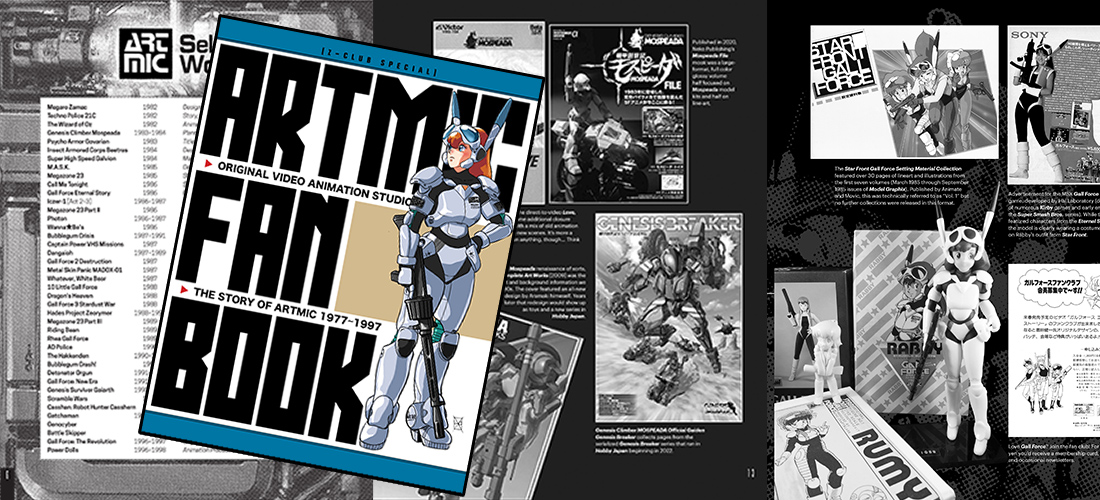
Our ARTMIC Fan Book is 56 pages of ARTMIC history, tracing the studio’s roots through to its unfortunate demise. Grab a copy at garagekit.club.
Notes
- It took me far too long to put this together, but between the biker gang origins and transforming motorcycle, Houquet is very much a protoype for Priss of Bubblegum Crisis [1987].
- A pop singer that came to national attention in the early ’80s via a TV talent show called Star Tanjo!
- While clearly not part of a Super Dimension “series” because advertising agency and sponsor Big West wasn’t involved, it’s worth mentioning how similar this title was to that of the original Macross. “Super Dimension Fortress” is written as 超時空要塞, while “Super Immortal Fortress” differs by only two characters: 超不滅要塞.
- It’s worth noting that every episode title referenced a type of music.
- Throughout 1983 and 1984, a number of TV anime featured transforming robots. With Super Dimension Century Orguss [1983], Powered Armor Dorvack [1983], and Super Dimension Cavalry Southern Cross [1984] being some of the more noteworthy examples. Unlike Macross, none of these shows proved to be big hits. Perhaps the most notable post-Macross transforming robot show was one that never really even hit the airwaves; Megazone 23 had originally been pitched as a TV series before getting reworked as an OVA.
- As a side note, the connection between ARTMIC and Imai was likely Toshimichi Suzuki himself, who had a side gig as an illustrator of model kit box art. In addition to working with Imai on their Macross kits, he also painted art for Galaxy Eagle Megalo-Zamak, an original model kit line that Imai produced without an anime tie-in. Imai also created model kits based on the ARTMIC-designed Armored Insect Corps Beetras.
- In terms of practical implementation, the Legioss/Tread combo strikes a balance somewhere between the Super Valkyrie of Macross and the G-Armor of Gundam. The fact that the Tread is its own vehicle that can also transform lent it a more toyetic quality.
- Mospeada’s Mechanical Supervisor and a Mechanical Designer on Megazone 23. He had an eclectic career under a number of pseudonyms, including working on the OVA Cyber City Oedo 808 and the PC-88/98 game, Jesus II.
- Possibly a misspelling of “moto-speeder.”
- In the show, new forces from Mars and Jupiter bring with them Dark Legioss and Dark Ride Armor units. These look largely the same as the more familiar Legioss and Ride Armor, but with a purple color scheme and stealth technology that prevented detection by the Inbit’s HBT sensors.